


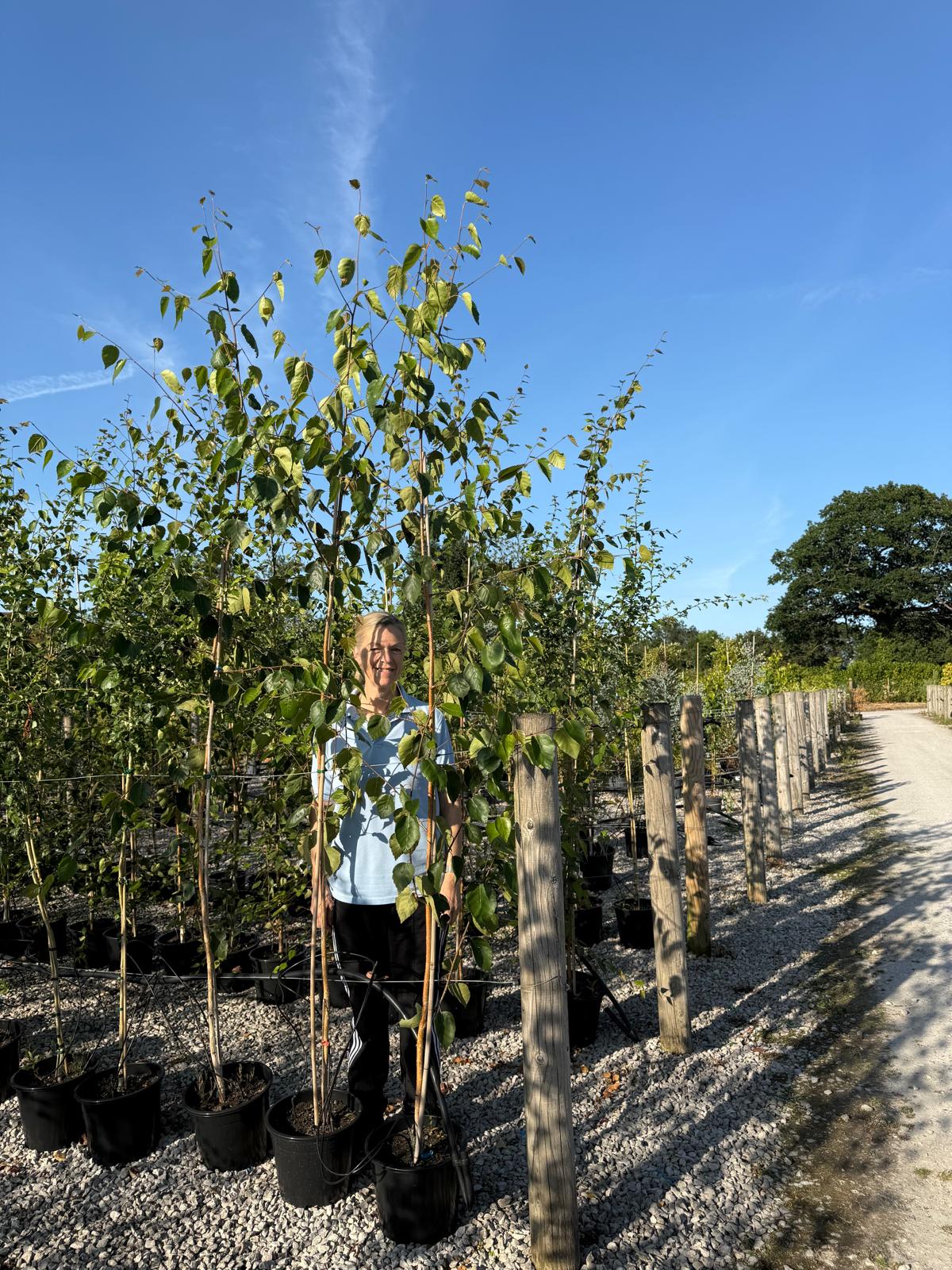

About Betula utilis var. jacquemontii 'Doorenbos' 7.5 Litre Pot 200cm
Betula utilis – Himalayan Birch – Breathtaking White Bark & Year-Round Garden Drama
Betula utilis, the Himalayan Birch, is one of the most celebrated ornamental trees in cultivation, prized above all for its dazzling, paper-white bark that glows like polished ivory even on the dullest winter's day. Native to the forests and mountain slopes of the Himalayas, this stately, fully hardy tree brings an extraordinary combination of elegance, seasonal colour and architectural structure to gardens of every style. Whether planted as a bold specimen, grouped in a naturalistic woodland setting, or used to line a driveway, Betula utilis delivers breathtaking year-round appeal that few other trees can match.
Seasonal Beauty & Growth
Spring: Delicate, bright green leaves unfurl in spring, their fresh colour making a vivid and lively contrast against the gleaming white trunk and branches below.
Summer: The canopy fills out into a graceful, airy crown of rich green foliage, casting dappled shade and giving the tree a soft, natural elegance throughout the warmer months.
Autumn: As temperatures cool, the leaves transition to warm shades of golden yellow, creating a stunning seasonal display before falling to reveal the tree's most prized feature once more.
Winter: The brilliant white bark truly comes into its own in the colder months, standing out magnificently against dark skies and frosty landscapes to provide unmissable structure and beauty when the garden needs it most.
Structure & Form
Habit: Betula utilis develops a graceful, upright to broadly columnar form with an open, airy canopy. Slender, arching branches spread naturally, giving the tree a light and elegant silhouette at every stage of maturity.
Bark: The defining feature of this species is its extraordinary peeling bark, which reveals smooth, creamy-white to brilliant white layers beneath. Bark colour and intensity can vary between specimens and selected clones, ranging from warm cream through to pure, dazzling white.
Mature size: In garden conditions, Betula utilis typically reaches a mature height of 10–20 metres with a spread of 6–10 metres, though growth rate and ultimate size will depend on growing conditions and the particular form or cultivar.
Catkins: Long, pendulous yellow-brown catkins appear in early spring before or alongside the emerging leaves, adding a further layer of seasonal interest to this already exceptional tree.
Perfect for Various Landscapes
Specimen Tree – Plant as a standalone focal point where its luminous white bark and graceful form can be admired from every angle throughout the year.
Woodland Gardens – Perfectly at home in naturalistic or woodland-style planting schemes, associating beautifully with ferns, shade-loving perennials and flowering shrubs.
Avenues & Driveways – Use in groups or rows to create a dramatic, corridor-style planting that delivers visual impact in every season.
Contemporary & Formal Gardens – The clean white trunk and refined silhouette make Betula utilis an equally strong choice for modern, architectural or formal garden designs.
Multi-Stem Planting – When grown or planted in multi-stem arrangements, the layered white bark creates an especially spectacular winter feature.
Growing Conditions
Position: Betula utilis thrives in full sun to partial shade. A position with good light will encourage the most vibrant bark colour and healthy, vigorous growth. It is well suited to exposed sites and is tolerant of a wide range of conditions.
Soil: Best grown in moist, well-drained soil with a slightly acidic to neutral pH. It will adapt to a range of soil types, including sandy or loamy soils, provided they do not become waterlogged. Good moisture retention is beneficial, particularly during the establishment period.
Hardiness: Fully hardy throughout the UK and across a wide range of climates, reflecting its origins in the high-altitude environments of the Himalayas. It tolerates cold winters with ease and is not troubled by frost.
Care & Pruning
Establishment: Water regularly during the first growing season to help the tree establish a strong root system. Once settled, Betula utilis is largely self-sufficient and requires minimal intervention.
Pruning: Birches are best pruned in late summer or autumn when they are not actively growing, as pruning during spring or early summer can cause heavy sap bleeding. Remove any dead, damaged or crossing branches as needed, and carry out any shaping at this time. General maintenance pruning requirements are low.
Bark care: To make the most of the ornamental bark, remove lower side branches over time to expose more of the trunk. Gently wiping the trunk with a soft, damp cloth in late winter can also help to enhance the brightness of the white bark, removing any accumulated grime or algae.
Feeding: Apply a balanced slow-release fertiliser in spring to support healthy growth, particularly in the early years after planting. Established trees in good soil generally require little additional feeding.
Perfect Plant Combinations
Evergreen Shrubs – Combine with dark-leaved evergreens such as Taxus, Prunus laurocerasus or Buxus to create a striking contrast that emphasises the brilliant white bark, particularly in
Plants well with
Our growers' picks to plant alongside Betula utilis var. jacquemontii 'Doorenbos' 7.5 Litre Pot 200cm for a fuller, longer-lasting display.
-
Hamamelis Arnolds Promise 20 Litre Pot 125/150cm Tall
Hamamelis × intermedia 'Arnold Promise'Full sunDeciduousGetting lowRegular price £165.00Regular price -
Cornus Kelseyi 2 Litre Pot
Cornus sericea 'Kelseyi'Full sunDeciduousIn stockRegular price £4.60Regular price

