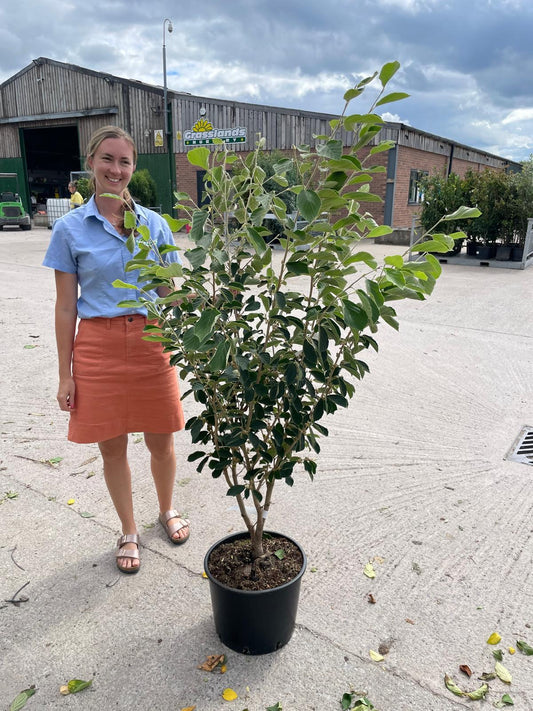




About Amelanchier Lamarckii 20 Litre Pot 125/150cm Tall
Amelanchier lamarckii – Snowy Mespilus / Juneberry
A Breathtaking Four-Season Tree with Blossom, Berries, and Blazing Autumn Colour
Amelanchier lamarckii, widely known as the Snowy Mespilus or Juneberry, is one of the most rewarding small trees you can grow in a temperate garden. Beloved for its spectacular early-spring blossom, edible summer berries, and fiery autumn foliage, it earns its place in the garden across every season. Its graceful, multi-stemmed form and manageable size make it an outstanding choice for gardens of all scales — equally at home as a statement specimen, a woodland-edge planting, or an anchor for a mixed border. Few trees offer such a complete package of beauty, wildlife value, and easy-going temperament.
Seasonal highlights
Spring blossom. The show begins in early spring, when bare branches become smothered in clusters of delicate, star-shaped white flowers — often before the leaves have fully emerged. The emerging foliage unfurls at the same time in soft coppery-bronze tones, creating a wonderful two-tone effect of white petals against warm, bronzed leaves. The blossom is a magnet for early-season pollinators, providing a vital nectar source for bees and other insects when little else is yet in flower.
Summer berries. As the flowers fade, small rounded berries develop, ripening from red through to deep purple-black by early summer. These sweet, blueberry-like fruits are entirely edible and can be enjoyed straight from the tree, or used in jams, crumbles, and pies. Birds — particularly thrushes, blackbirds, and waxwings — adore them too, so expect the tree to become a hub of garden wildlife through the summer months.
Autumn colour. As temperatures drop, A. lamarckii puts on one of the most vivid autumn displays of any small tree, with foliage turning brilliant shades of orange, red, and scarlet. The intensity of colour rivals many Japanese maples and makes this tree a genuine focal point well into the back end of the year.
Winter silhouette. Even in the dormant season, the elegant branching framework and smooth grey-brown bark retain quiet architectural interest, particularly when lit by low winter sun or dusted with frost.
Growing conditions
Position. Amelanchier lamarckii thrives in full sun to partial shade. A sunny, open position will produce the most prolific blossom, the best fruit set, and the richest autumn colour, though it performs reliably in dappled shade too — ideal for woodland-edge or understorey planting. It is fully hardy across the British Isles and most of temperate Europe, tolerating exposure and cold winters without difficulty.
Soil. This tree is adaptable to a wide range of soils, but performs best in moist, well-drained, fertile ground. It has a preference for slightly acidic to neutral conditions and will particularly thrive in soils with a good organic content. It tolerates clay soils provided they are not waterlogged for prolonged periods, and will also grow in loam and lighter sandy soils as long as adequate moisture is maintained during dry spells. Avoid highly alkaline or chalk soils, which can cause lime-induced chlorosis.
Care
Watering. Water regularly during the first growing season to help the tree establish a strong root system. Once settled, A. lamarckii is reasonably drought-tolerant, but will benefit from deep watering during extended dry periods, particularly on lighter soils. A generous mulch around the base helps retain soil moisture and keep roots cool through summer.
Feeding. An application of a balanced, slow-release fertiliser in early spring will support healthy growth and a good berry crop. On naturally fertile soils, additional feeding is rarely necessary once the tree is established.
Pruning. Amelanchier lamarckii requires very little pruning to maintain its naturally graceful shape. Remove any dead, damaged, or crossing branches in late winter or early spring before growth resumes. If grown as a multi-stemmed shrub-tree, occasional thinning of congested stems will improve light and air circulation. If training to a single-stem standard form, remove competing leaders and basal suckers promptly when young. Avoid heavy pruning, which can reduce flowering and fruiting the following season.
Mulching. Apply a layer of organic mulch — such as composted bark or leaf mould — around the base of the tree each spring. This suppresses weeds, retains moisture, regulates soil temperature, and gradually improves soil structure as it breaks down. Keep the mulch clear of direct contact with the trunk to prevent rot.
Pests and disease. Amelanchier lamarckii is generally healthy and trouble-free. It can occasionally be affected by fireblight, aphids, or leaf spot in unfavourable conditions, but serious problems are uncommon. Good air circulation, avoiding waterlogged soil, and removing any affected growth promptly will keep the tree in good health. It is not prone to significant pest damage.
Garden uses and planting ideas
Specimen tree. With its multi-season appeal and elegant, arching habit, A. lamarckii makes a superb standalone specimen in a lawn or border, where all aspects of its seasonal performance can be fully appreciated. Plant it where the spring blossom can be seen against a dark background — a yew or holly hedge, for instance — to maximise the visual impact of the white flowers.
Wildlife and naturalistic gardens. Few small trees contribute more to garden biodiversity. The spring blossom feeds early pollinators, the summer berries sustain birds and small mammals, and the canopy provides shelter and
Plants well with
Our growers' picks to plant alongside Amelanchier Lamarckii 20 Litre Pot 125/150cm Tall for a fuller, longer-lasting display.
-
Hamamelis Arnolds Promise 20 Litre Pot 125/150cm Tall
Hamamelis × intermedia 'Arnold Promise'Full sunDeciduousGetting lowRegular price £165.00Regular price -
Cornus Kelseyi 2 Litre Pot
Cornus sericea 'Kelseyi'Full sunDeciduousIn stockRegular price £4.60Regular price -
Helleborus Niger Christmas Carol 12cm Pot
Helleborus niger 'Christmas Carol'Semi-evergreenIn stockRegular price £8.15Regular price