

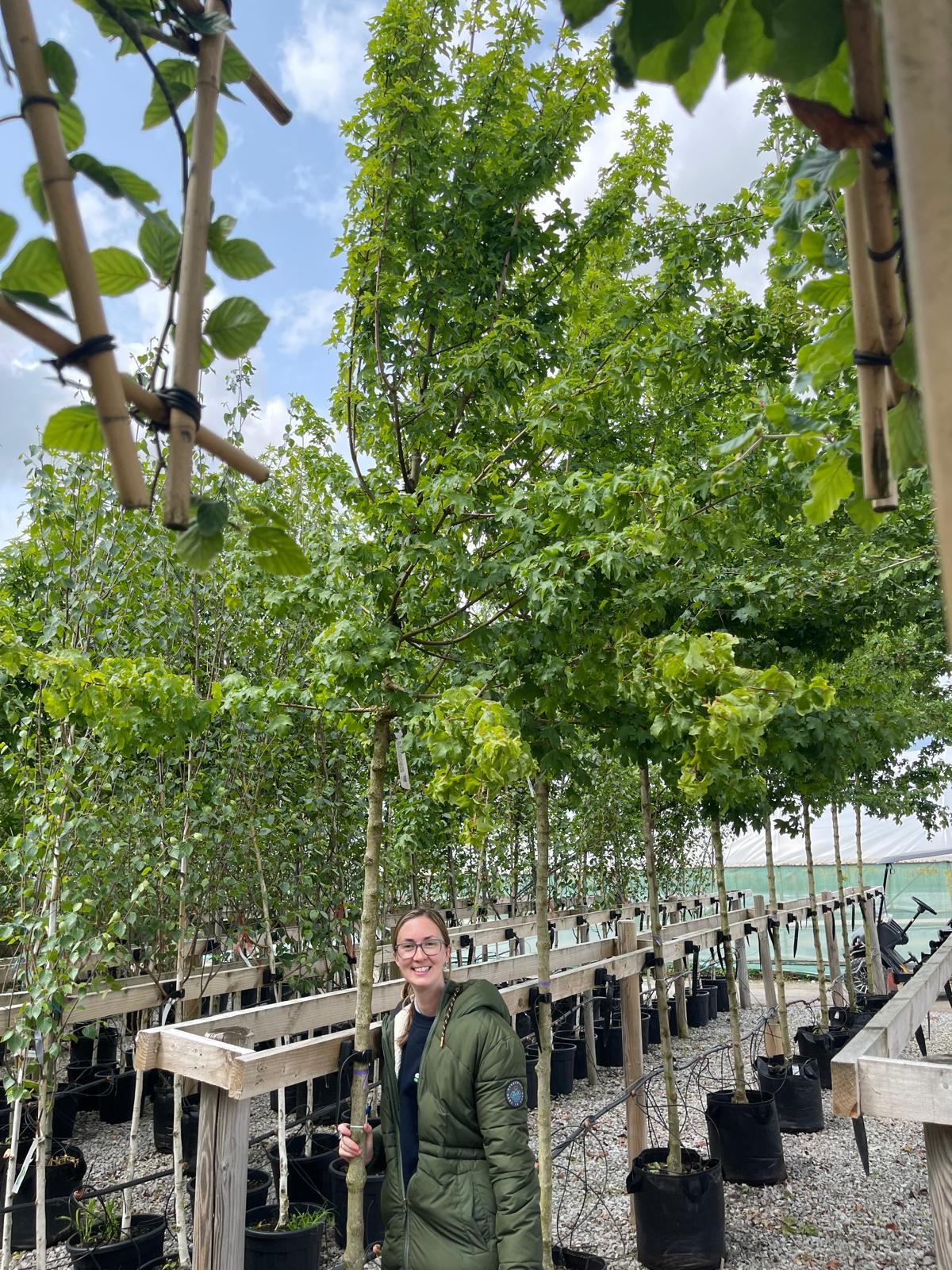
About Acer campestre Elsrijk 12/14cm Girth 50 Litre Pot
Acer campestre 'Elsrijk' – A Compact and Resilient Field Maple
Acer campestre 'Elsrijk' is a refined, compact variety of the native Field Maple, prized for its dense, uniform crown and vibrant seasonal foliage. With a naturally upright growth habit and excellent tolerance to urban conditions, it is an ideal choice for streetscapes, small gardens, and formal landscapes.
Seasonal Beauty & Growth
In spring, fresh bright green leaves emerge, forming a dense and neatly rounded canopy. By summer, the foliage maintains its rich green colour, providing an elegant, structured appearance. Come autumn, golden-yellow hues take over, creating a spectacular seasonal display before the leaves fall. Small, yellow-green flowers appear in spring, followed by distinctive winged seeds (samaras) in autumn.
Structure & Form
Acer campestre 'Elsrijk' has a more compact, upright growth habit than the standard Field Maple, reaching 8–10m in height with a dense, oval-shaped crown. Its smooth, grey-brown bark develops subtle ridges with age, adding year-round interest. Unlike the standard species, 'Elsrijk' maintains a naturally uniform shape, requiring little pruning.
Perfect for Various Landscapes
- Street & Urban Planting – Pollution-tolerant and ideal for avenue planting.
- Small & Formal Gardens – Compact size and tidy form make it a great feature tree.
- Commercial & Public Spaces – Used in parks, business developments, and plazas.
- Wildlife-Friendly Gardens – Provides habitat and food for pollinators and birds.
Growing Conditions & Care
- Position: Thrives in full sun to partial shade.
- Soil: Adaptable to chalky, clay, loamy, or sandy soils; prefers well-drained conditions.
- Hardiness: Fully frost and drought-tolerant once established.
- Maintenance: Minimal pruning is required due to its naturally compact shape.
Why Choose Acer campestre 'Elsrijk'?
With its neat, upright form, resilience, and striking seasonal colour, Acer campestre 'Elsrijk' is an excellent choice for those looking for a low-maintenance, structured tree for urban or garden settings. Whether planted as a feature tree, in rows for avenue planting, or mixed landscapes, it offers beauty, durability, and ecological benefits.
Perfect Plant Combinations
- Evergreens – Pair with evergreens like Taxus baccata (English Yew) or Juniperus communis for year-round contrast and structure.
- Flowering Shrubs – Rhododendron or Spiraea provide color contrast in spring and summer while complementing the tree’s seasonal leaf changes.
- Perennials – Hosta, Astilbe, or Heuchera work well in shaded areas beneath the canopy, adding texture and interest.
- Groundcovers – Low-growing plants like Vinca minor (Periwinkle) or Pachysandra can fill in spaces beneath the tree, offering a green carpet and minimizing weeds.
- Other Deciduous Trees – Pair with smaller trees like Prunus species (Cherry trees) or Malus species (Crabapple) for a beautiful layered landscape with complementary foliage and flowers.
Plants well with
Our growers' picks to plant alongside Acer campestre Elsrijk 12/14cm Girth 50 Litre Pot for a fuller, longer-lasting display.
-
Hosta Sieboldiana Elegans 2 Litre Pot
Hosta sieboldiana var. elegansPartial shadeDeciduousIn stockRegular price £5.45Regular price -
Dryopteris erythrosora - Autumn Fern 2 Litre Pot
Dryopteris erythrosoraFull sunSemi-evergreenIn stockRegular price £6.00Regular price -
Pieris Japonica Flaming Silver 7.5 Litre Pot
Pieris japonica 'Flaming Silver'EvergreenIn stockRegular price £40.50Regular price -
Hamamelis Arnolds Promise 20 Litre Pot 125/150cm Tall
Hamamelis × intermedia 'Arnold Promise'Full sunDeciduousGetting lowRegular price £165.00Regular price


