


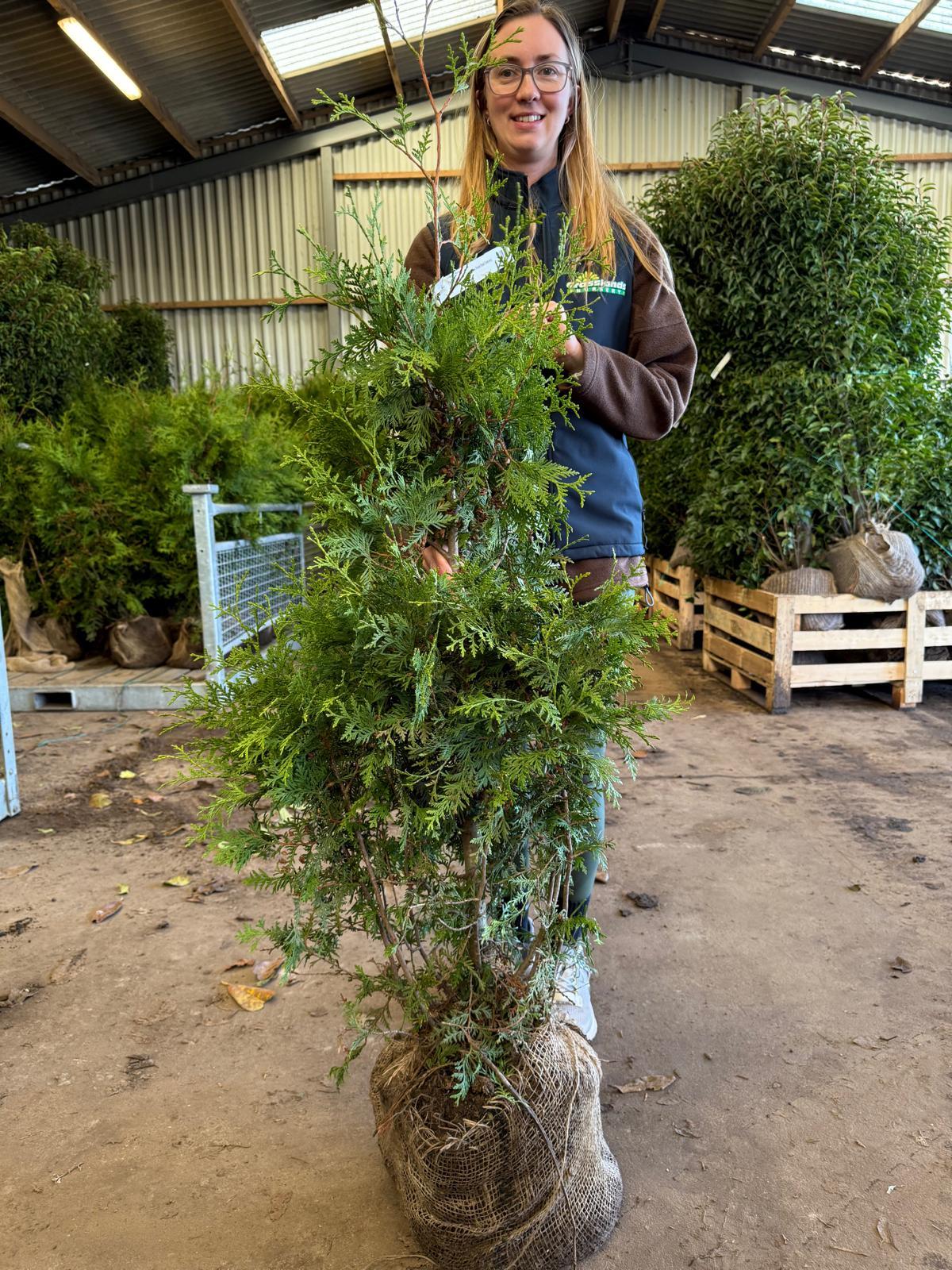
Thuja Brabant 100-125cm Root Ball
Thuja Brabant 100-125cm Root Ball

Couldn't load pickup availability

About Thuja Brabant 100-125cm Root Ball
Thuja occidentalis 'Brabant' – White Cedar / American Arborvitae
Thuja occidentalis 'Brabant' is a fast-growing, columnar evergreen conifer prized for its dense, soft-textured foliage and naturally upright habit. Producing rich green, scale-like sprays that hold their colour reliably through all four seasons, 'Brabant' is one of the most popular choices for privacy hedging, windbreaks, and structured garden planting across the UK. Its elegant, narrow form and vigorous growth rate mean it delivers effective screening quickly, while remaining far easier to manage than many comparable conifers.
With its tolerance for a wide range of soils and conditions, year-round evergreen coverage, and excellent response to clipping, Thuja 'Brabant' is equally at home in formal garden designs, rural shelter belts, and everyday suburban boundaries. A reliable, low-fuss performer that repays straightforward care with consistent, attractive growth.
Habit & Appearance
Form and foliage. 'Brabant' develops a strongly upright, columnar silhouette that naturally stays neat and well-defined without excessive intervention. The foliage is arranged in flat, feathery sprays of soft, aromatic, mid-green scale-like leaves. In spring, fresh growth emerges in a slightly brighter, lime-tinged green before deepening to a full, lush mid-green through summer. Unlike many conifers, 'Brabant' holds its colour well into autumn and winter, providing structural interest and visual coverage throughout the coldest months. Left unpruned, plants can ultimately reach 5–6 metres or more in height, though they are easily maintained at any desired height with regular trimming.
Growth rate. One of 'Brabant's' most valued qualities is its vigorous growth — under good conditions it can put on 40–60 cm per year, making it one of the fastest-establishing hedging conifers available. This rapid growth, combined with its dense branching habit, means effective screening can be achieved relatively quickly after planting.
Growing Conditions
Position. Thuja 'Brabant' thrives in full sun to partial shade. It performs best in an open, sunny aspect but tolerates dappled shade well, making it versatile for planting alongside walls, fences, or existing trees. It is fully hardy throughout the UK and withstands exposed sites and cold winds, making it an excellent choice for shelter belt planting in more challenging locations.
Soil. Adaptable to most fertile, well-drained soils, including clay, loam, and sandy ground. 'Brabant' tolerates moderately moist conditions better than many conifers but will not thrive in waterlogged or poorly drained ground. Improving drainage and incorporating organic matter at planting will give the best results on heavier soils. A slightly acid to neutral soil pH suits this species well, though it copes with mildly alkaline conditions too.
Planting spacing. For a dense, uniform hedge, plant approximately 60–80 cm apart. For a quicker, thicker initial screen, spacing plants closer at around 50–60 cm will encourage faster canopy closure. For shelter belts or more informal planting, wider spacing of up to 1 metre is acceptable as the plants will naturally bush out over time.
Care
Watering. Water regularly and thoroughly during the first growing season after planting to allow the root system to establish fully. This is especially important during dry spells in spring and summer. Once established, Thuja 'Brabant' becomes reasonably drought tolerant and will require supplementary watering only during prolonged dry periods.
Feeding. Apply a balanced, slow-release granular fertiliser in early spring to support strong, healthy growth. A feed formulated for conifers or hedging plants is ideal. Mulching around the base with bark or compost in spring helps retain moisture, suppress weeds, and protect roots from temperature extremes.
Pruning. One of the great advantages of 'Brabant' is its natural inclination to hold a neat, upright form. Light trimming once or twice a year — ideally in late spring and again in late summer — is all that is required to maintain a crisp, formal hedge line. Avoid cutting back hard into old, brown wood, as Thuja does not regenerate readily from bare stems. Regular, modest trimming from an early stage produces the densest and most attractive results. If left untrimmed, 'Brabant' will develop a more relaxed, conical shape that still looks attractive in informal settings.
Ideal Uses
Privacy and security screening – Dense, year-round foliage provides effective visual and noise screening for gardens and properties.
Windbreaks and shelter belts – Strong, bushy growth offers excellent wind protection for exposed plots and rural locations.
Formal hedging – Clips cleanly to a precise, uniform line for structured, formal garden schemes.
Garden boundaries – An attractive, evergreen alternative to fencing that softens boundaries with natural greenery.
Specimen planting – A single plant or a small group creates a bold, vertical accent in mixed borders or open lawn settings.
Why Choose Thuja occidentalis 'Brabant'?
Fast-growing – Establishes quickly for earlier screening and shelter.
Evergreen year-round – Rich green foliage provides colour and coverage in every season.
Low maintenance – Naturally tidy habit with minimal
Plants well with
Our growers' picks to plant alongside Thuja Brabant 100-125cm Root Ball for a fuller, longer-lasting display.
-
Taxus baccata 'Groenland' - Yew 3 Litre Pot
Taxus baccata 'Groenland'Full sunEvergreenIn stockRegular price £8.50Regular price -
Chamaecyparis pisifera Sungold - Sawara Cypress Sungold 3 Litre Pot
Chamaecyparis pisifera 'Sungold'Full sunEvergreenIn stockRegular price £7.60Regular price -
Juniperus Blue Arrow 10 Litre Pot
Juniperus scopulorum 'Blue Arrow'Full sunEvergreenIn stockRegular price £45.00Regular price


