

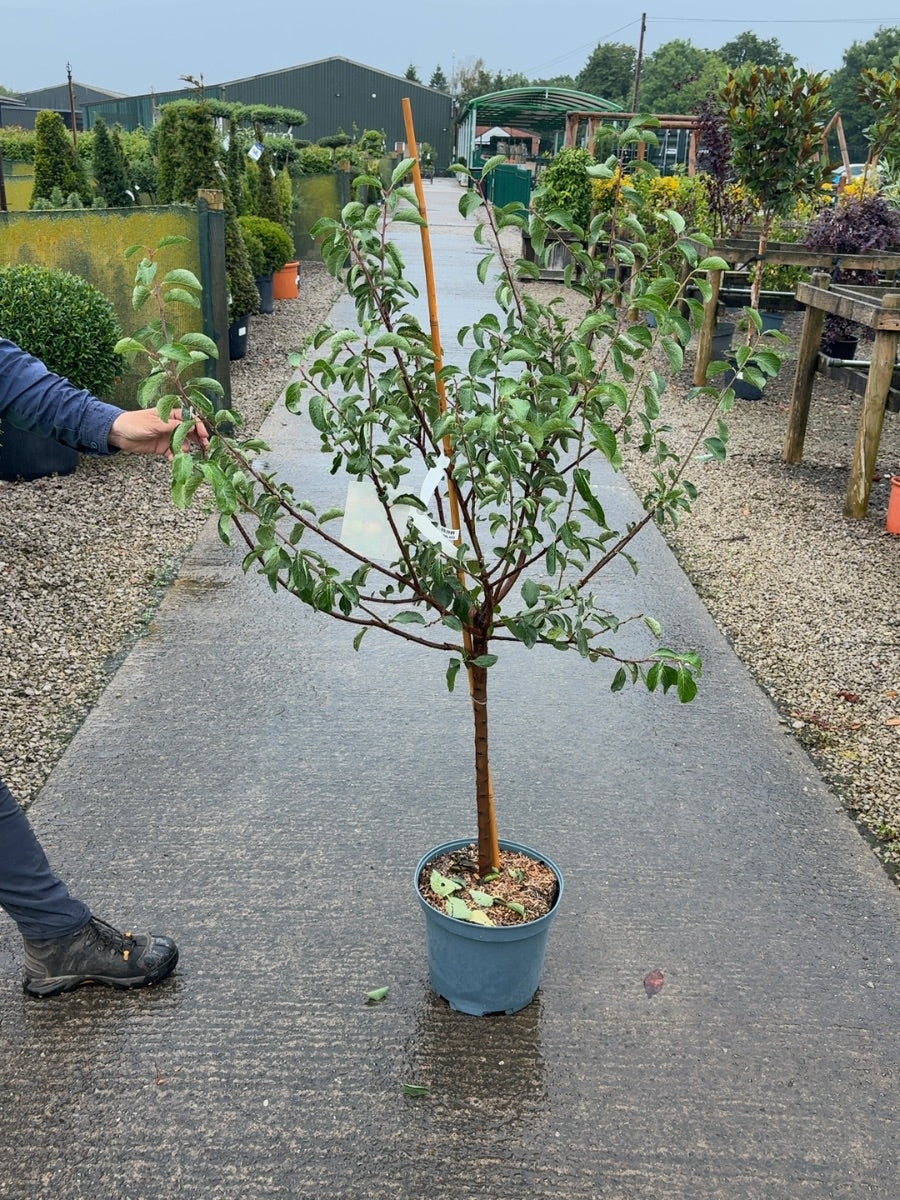
About Plum Prunus Dom. Mirabelle de Nancy 10 Litre Pot Goblet
Mirabelle Plum (Prunus domestica 'Mirabelle de Nancy') – A Charming Fruiting Tree with Exceptional Flavour
Prunus domestica 'Mirabelle de Nancy' is one of the most beloved and characterful of all fruiting plums — a small, elegant tree that earns its place in the garden through both its ornamental beauty and the outstanding quality of its fruit. Originating from the Lorraine region of France, where it remains a celebrated culinary treasure, Mirabelle de Nancy produces abundant clusters of small, golden-yellow plums flushed with a warm red blush, sweet, rich, and intensely flavoured in a way that few other plums can match.
In spring, the bare branches are smothered in a froth of delicate white blossom before the leaves emerge — a truly striking seasonal display. By late summer, the tree rewards patient gardeners with generous crops of jewel-like fruit, superb eaten fresh from the tree or transformed into jams, tarts, preserves, and the famous Mirabelle eau-de-vie of its home region. Compact enough for smaller gardens yet generous in its fruiting, this is a tree that offers year-round interest and genuine culinary reward.
Key Features
Prolific crops of small, golden-yellow plums with a sweet, richly aromatic flavour
Beautiful white blossom in spring before the foliage emerges
Compact, manageable tree suitable for smaller gardens and trained forms
Fruit ripens in late summer — excellent for eating fresh, preserving, and cooking
Partially self-fertile, though crops are improved with a compatible pollinator nearby
Growing Conditions
Position: For the best blossom and heaviest fruit set, plant Mirabelle de Nancy in a warm, sheltered spot in full sun. A south- or south-west-facing aspect is ideal, as the tree benefits from warmth to ripen its fruit fully and needs some protection from cold spring winds that can damage the early blossom. It will tolerate a lightly sheltered partially shaded position, though cropping will be reduced. Training against a warm wall is an excellent option in cooler or more exposed gardens.
Soil: Mirabelle de Nancy performs best in fertile, moisture-retentive but well-drained soil. It adapts well to a range of soil types, including loam and light clay, provided waterlogging is avoided — standing water around the roots during winter can be particularly damaging. A slightly acid to neutral pH is preferred. Avoid very shallow, chalky, or excessively sandy soils unless well-amended with organic matter.
Hardiness: Fully hardy throughout the UK and much of Northern Europe. However, as with all early-flowering plums, late spring frosts present the greatest risk — not to the tree itself, but to the open blossom and developing fruitlets. A sheltered planting position is strongly recommended to minimise frost damage and protect the crop.
Habit & Appearance
Form & Foliage: Mirabelle de Nancy forms a rounded, moderately vigorous deciduous tree with an attractive, open branching structure. The mid-green leaves are oval and slightly toothed, providing a fresh, pleasant canopy through spring and summer before taking on warm yellow tones in autumn as the season turns.
Blossom: One of the tree's finest ornamental qualities is its spring flowering. Pure white, five-petalled blossoms appear in mid-spring, typically in April, clothing the branches before the foliage fully unfurls. The display is abundant and showy, with a gentle fragrance that attracts early-season pollinators.
Fruit: The plums are small and round — characteristically no larger than a large cherry — and ripen to a glowing golden yellow with an attractive red or orange blush on the sunny side. The flesh is pale yellow, clinging to a small stone, and offers a honeyed sweetness with a depth of flavour that sets Mirabelle apart from larger, more commonplace plums. Fruit typically ripens from late July to mid-August, depending on season and situation.
Ultimate Size: On a standard rootstock, Mirabelle de Nancy will reach approximately 4–5m in height with a similar spread at maturity, though grafted onto semi-dwarfing rootstocks it can be maintained considerably smaller. It responds well to formative pruning and can also be trained as a fan or pyramid.
Care & Pruning
Watering: Water regularly during the first one to two growing seasons to help the tree establish a strong root system. Once settled in, Mirabelle de Nancy is reasonably drought-tolerant, though consistent moisture during the fruit development period in early to midsummer will noticeably improve both crop size and fruit quality. Avoid allowing the soil to dry out completely while the fruit is swelling.
Feeding: Apply a balanced general-purpose fertiliser or a dedicated fruit tree feed in early spring to support healthy growth and generous fruiting. An annual mulch of well-rotted garden compost or manure around the base of the tree — keeping it clear of the trunk — will help retain soil moisture, suppress weeds, and slowly release nutrients as it breaks down.
Pruning: Prune plums during the active growing season — late spring or summer — rather than in winter, as all members of the Prunus family are
Plants well with
Our growers' picks to plant alongside Plum Prunus Dom. Mirabelle de Nancy 10 Litre Pot Goblet for a fuller, longer-lasting display.
-
Amelanchier aln. Obelisk 12 Litre Pot 100/125cm
Amelanchier alnifolia 'Obelisk'Full sunDeciduousPre-orderRegular price £55.50Regular price -
Magnolia Black Tulip 20 Litre Pot 150/175cm
Magnolia Black Tulip ('Jurmag1')Full sunDeciduousGetting lowRegular price £193.50Regular price -
Geranium Johnson's Blue 2 Litre Pot
Geranium × johnsonii 'Johnson's Blue'Full sunDeciduousGetting lowRegular price £4.60Regular price


