

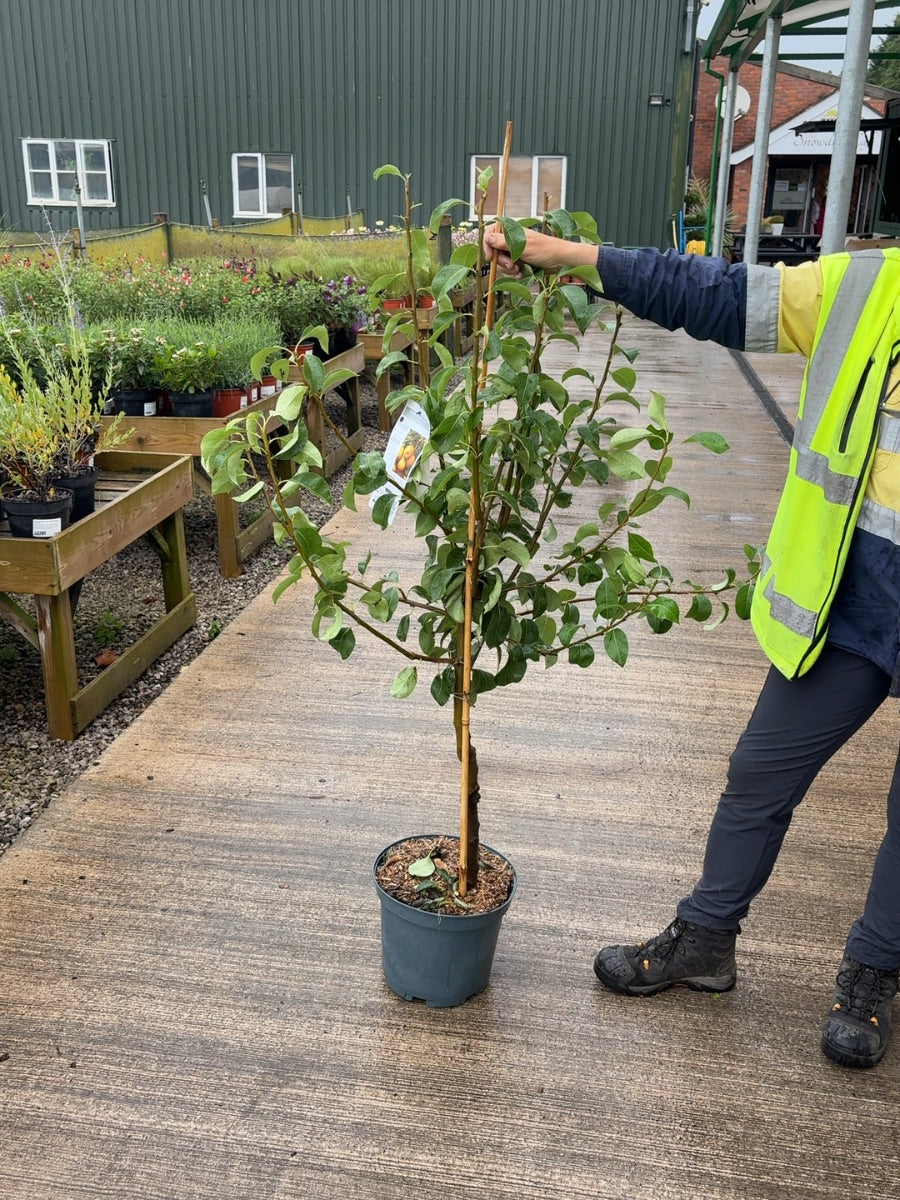
About Pear Beurre Hardy 10 Litre Pot Goblet
Pyrus communis 'Beurre Hardy' is a classic, time-honoured dessert pear tree prized for its rich, buttery fruit, reliable cropping, and beautiful spring blossom. One of the most celebrated traditional pear varieties, it has been cultivated for generations and remains a favourite in orchards and gardens across the UK.
With its elegant upright habit, clouds of white spring flowers, and handsome russet-skinned fruits ripening in early to mid-autumn, Beurre Hardy delivers both ornamental appeal and a genuinely rewarding harvest season after season.
Hardy, adaptable, and relatively straightforward to maintain, this is an outstanding choice for anyone looking to establish a productive fruit tree with enduring character and quality.
Habit and Appearance
Classic upright, spreading habit. Pyrus communis 'Beurre Hardy' develops into a handsome deciduous tree with a naturally upright to broadly spreading crown. In spring, the bare branches are smothered in clusters of delicate, five-petalled white flowers, creating a striking display that is also highly attractive to early-season pollinators, particularly bees.
Attractive foliage and fruit. The mid-green leaves are oval and glossy, taking on warm yellow and orange tints in autumn before falling. The pears themselves are medium to large in size, with a distinctive greenish-yellow skin overlaid with russeting. The flesh is smooth, buttery, and exceptionally juicy, with a sweet, rose-water-tinged flavour that has made this variety a benchmark for dessert pear quality. Fruits typically ripen in September to early October and are best eaten fresh shortly after picking.
Vigorous and long-lived. Given the right conditions, Beurre Hardy is a vigorous, long-lived tree that builds in productivity as it matures, becoming a genuine feature and a reliable annual fruiting asset in the garden or orchard.
Growing Conditions
Position. Plant in a sheltered spot in full sun for the best fruit development and blossom display. A south- or west-facing aspect is ideal. While tolerant of some exposure, shelter from strong winds helps protect the spring blossom and ensures good pollination and fruit set. Wall-training as an espalier or fan on a warm, south-facing wall is particularly effective in cooler or more exposed gardens.
Soil. Beurre Hardy thrives in deep, fertile, moisture-retentive but well-drained soil. It performs well in loam, clay-loam, or sandy loam with a slightly acidic to neutral pH. Avoid sites prone to prolonged waterlogging, which can cause root stress and reduce vigour. Incorporating well-rotted organic matter at planting helps establish the tree in lighter or poorer soils.
Hardiness. Fully hardy throughout the UK (RHS H6), tolerating frost and cold winters with ease. The blossom is produced early in the season and can occasionally be caught by late frosts, so a sheltered position or frost-pocket-free site is advisable where spring frosts are a regular occurrence.
Pollination. Beurre Hardy is partially self-fertile but crops significantly better when grown alongside a compatible pollination partner in the same flowering group. Excellent partners include Pyrus communis 'Conference', 'Williams' Bon Chrétien', or 'Concorde'. Even in smaller gardens, neighbouring trees can often provide sufficient pollination.
Care
Watering. Regular watering during the first growing season is essential to support establishment. Once the tree is established, it is moderately drought-tolerant, though consistent moisture during the growing season — particularly during fruit development — will improve both yields and fruit quality. Avoid allowing the soil to dry out completely in prolonged dry spells.
Feeding. Apply a balanced general-purpose or fruit tree fertiliser in early spring as growth begins. A top-dressing of well-rotted compost or farmyard manure around the base of the tree each autumn helps maintain soil fertility and structure. Avoid excessive nitrogen, which encourages leafy growth at the expense of fruit production.
Mulching. Maintain a generous mulch of bark chip, compost, or well-rotted manure around the base of the tree, keeping it clear of the trunk. Mulching conserves moisture, suppresses competing weeds, and moderates soil temperature — all of which benefit establishment and ongoing health.
Pruning. Prune in late winter or early spring while the tree is still dormant. The aim is to maintain an open, balanced framework that allows good light and air circulation into the canopy — both of which are essential for fruit quality and disease prevention. Remove any dead, damaged, or crossing branches, and shorten the previous season's growth on lateral shoots to encourage fruiting spurs. Established trees benefit from annual light pruning to maintain their form and productivity. For espalier or fan-trained specimens, formative training and summer pruning in July to August will keep the structure neat and productive.
Pests and diseases. Beurre Hardy shows reasonable resilience to many common pear problems. Monitor for pear leaf blister mite, pear sucker, and aphids during the growing season, and treat promptly if infestations develop. Ensure good air circulation through regular pruning to reduce the risk of fungal issues such as pear scab. Fireblight, though less common, should be watched for and affected material removed and destroyed immediately if seen.
Design Ideas
Orchard and kitchen garden centrepiece. Grown as a traditional standard or half-standard, Beurre Hardy makes a magnificent specimen in a productive orchard or large kitchen garden, delivering ornamental blossom in spring and