

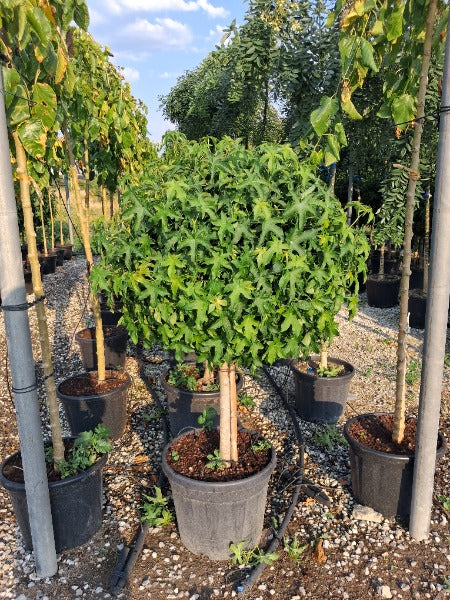

About Liquidambar Gumball Quatre Standard 45 Litre Pot
Liquidambar styraciflua 'Gumball' – Compact Globe-Shaped Sweetgum with Fiery Autumn Colour
Liquidambar styraciflua 'Gumball', commonly known as Sweet gum, is a compact, slow-growing deciduous tree celebrated for its naturally rounded, globe-shaped habit and spectacular seasonal foliage. Through spring and summer the canopy is dressed in glossy, star-shaped green leaves that transform into a breathtaking palette of fiery oranges, rich reds, and deep purples as autumn arrives — delivering months of colour and drama in even the smallest of spaces.
Its restrained size, tidy symmetrical form, and minimal maintenance requirements make 'Gumball' an outstanding choice for gardeners who want maximum seasonal impact without sacrificing space.
Habit & Appearance
Form & foliage. 'Gumball' produces a naturally symmetrical, ball-shaped crown that requires little or no corrective pruning to maintain its rounded outline. The deeply lobed, star-shaped leaves are a hallmark of the Liquidambar genus and emerge fresh green in spring, deepening to a rich glossy green through summer before igniting in autumn. Even in winter, after leaf fall, the sculptural silhouette and finely textured bark retain year-round structural appeal.
Growth rate & size. This cultivar is slow to moderate in its rate of growth, eventually forming a compact, rounded tree well-suited to urban gardens, courtyard settings, avenues, and formal schemes. Its restrained spread means it can be used in situations where a full-sized Liquidambar would quickly outgrow its position.
Growing Conditions
Position. Plant 'Gumball' in a full sun position for the densest foliage and the most vivid autumn colour display. It will tolerate partial shade, though colour intensity may be reduced. It performs well in exposed and urban environments, showing good tolerance of wind and pollution.
Soil. Thrives in moist, well-drained soil and is adaptable to a range of soil types including clay and loam. For the richest autumn colour, a slightly acidic to neutral soil is preferred. Avoid shallow chalky or very dry soils where possible, as consistently moist conditions encourage the most vigorous growth and brightest seasonal display.
Hardiness. Fully hardy across the UK (RHS H6), tolerating frost, cold winds, and typical winter conditions without issue.
Care & Pruning
Watering. Water thoroughly and regularly during the first growing season to help the root system establish. Once settled, 'Gumball' develops reasonable drought tolerance, though occasional deep watering during prolonged dry spells will encourage healthy growth and maintain the quality of the autumn colour.
Feeding. Feeding is not routinely necessary in fertile soils. Where soils are poor or sandy, a balanced slow-release fertiliser applied in early spring will support healthy growth and foliage quality.
Mulching. Apply a generous layer of organic mulch around the base each spring to retain moisture, suppress weeds, and regulate soil temperature. Keep mulch clear of the trunk to prevent rot.
Pruning. Very little pruning is needed thanks to 'Gumball's naturally neat, rounded form. Remove any dead, damaged, or crossing branches during late winter while the tree is dormant. Avoid heavy pruning as the tree's ornamental shape develops best when left to its own devices.
Design Ideas
Feature tree. Use 'Gumball' as a standalone focal point in a lawn, border, or courtyard where its rounded profile and seasonal colour changes can be fully appreciated throughout the year.
Formal schemes & avenues. Its consistent, symmetrical habit makes it ideal for paired or repeated plantings along pathways, driveways, or formal garden borders, providing rhythm and structure.
Planting combinations. Pair with evergreen shrubs such as Buxus, Taxus, or Ilex to provide a dark, contrasting backdrop that intensifies the autumn foliage display. Underplant with shade-tolerant perennials such as Heuchera or Geranium for layered seasonal interest.
Urban & patio planting. The compact, slow-growing nature of 'Gumball' makes it a strong candidate for smaller urban gardens and patio settings where space is at a premium but seasonal drama is still desired.