
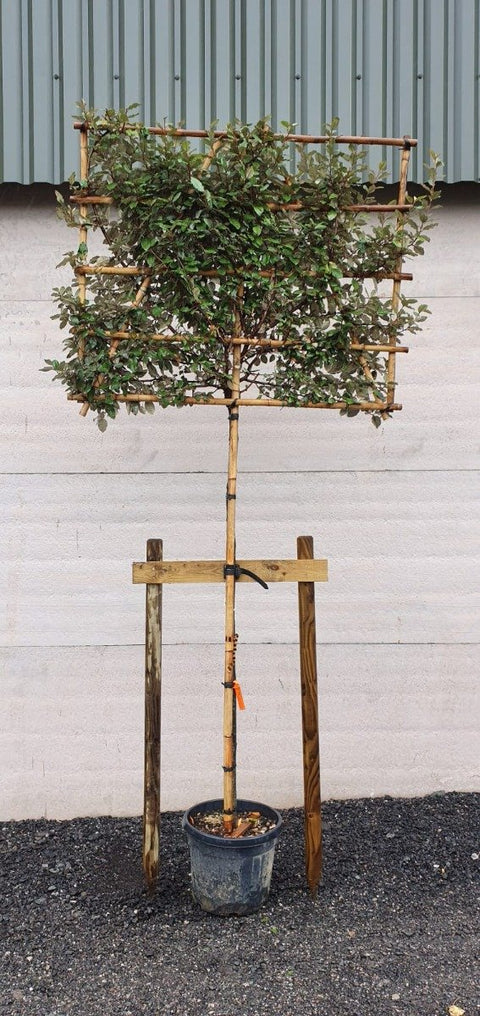
Ilex Nellie Stevens 1/4 Standard 9 Litre Pot 50cm Stem
Ilex Nellie Stevens 1/4 Standard 9 Litre Pot 50cm Stem
Couldn't load pickup availability
Order now to reserve your plants at today's price. We'll email you with a delivery date as soon as they're ready to dispatch.
About Ilex Nellie Stevens 1/4 Standard 9 Litre Pot 50cm Stem
Ilex × altaclerensis 'Nellie Stevens' (Holly)
Bold, vigorous, and enduringly handsome, Ilex × altaclerensis 'Nellie Stevens' is one of the finest hollies available to the British gardener. A hybrid of distinguished pedigree, it produces broad, glossy dark green leaves that are larger than those of the common holly and carry a distinctly lustrous, architectural quality that commands attention throughout every season. The foliage is moderately spined — enough to retain the classic holly character, but less ferociously prickly than many alternatives, making it a more manageable choice for gardens where access is a consideration.
In spring, clusters of small, creamy white flowers emerge amongst the foliage, attracting bees and other beneficial insects. By autumn and into winter, female plants bearing fertile flowers are rewarded with a generous crop of vivid red berries that light up the garden in the colder months and provide a vital food source for blackbirds, thrushes, and other berry-feeding birds. The combination of bold evergreen foliage and brilliant winter fruit makes 'Nellie Stevens' a plant of genuine year-round interest and wildlife value.
Naturally vigorous and upright in habit, Ilex × altaclerensis 'Nellie Stevens' is equally at home grown as a freestanding specimen tree, shaped into a formal standard, or trained as a dense, impenetrable hedge or screen. It suits formal and naturalistic planting schemes alike, and its tolerance of urban pollution, coastal exposure, and a wide range of soils makes it one of the most versatile and dependable structural evergreens available.
Growing conditions
Position: Thrives in full sun to partial shade. A position in good light encourages the richest, glossiest foliage and the most prolific berry production, though 'Nellie Stevens' adapts well to shadier aspects and retains a healthy, attractive appearance even in less bright conditions. It tolerates exposed and coastal sites with considerable resilience.
Soil: Grows well in most fertile, moist, well-drained soils. It performs best in slightly acidic to neutral conditions but shows reasonable tolerance of a wide range of soil types, including heavier loams, provided waterlogging is avoided. Good drainage is the single most important factor in establishing a healthy, long-lived plant.
Hardiness: Fully hardy throughout the UK and well suited to a variety of garden environments, including urban gardens, exposed sites, and coastal areas where wind and salt spray would trouble less robust evergreens. Once established, 'Nellie Stevens' is exceptionally tough and long-lived.
Care
Watering: Water consistently during the first season or two after planting to support strong root establishment. Once settled in, 'Nellie Stevens' is a robust and resilient plant that copes well with drier periods, though supplementary watering during prolonged drought — particularly in free-draining soils — will help to maintain vigour and encourage good berry set.
Feeding: An application of a balanced general fertiliser in spring supports healthy growth and helps maintain the richness and lustre of the foliage. Mulching around the base each spring or autumn with well-rotted organic matter is beneficial, helping to conserve soil moisture, moderate root temperature, and suppress competing weeds, all of which contribute to a more vigorous and productive plant.
Pruning: When grown as a freestanding specimen or small tree, 'Nellie Stevens' requires minimal pruning beyond the removal of any dead, crossing, or wayward branches, ideally carried out in late summer once the risk of frost has passed. When used as a hedge or screen, it responds well to clipping and can be trimmed to shape in late summer — avoid pruning in early spring to preserve the developing flower buds and subsequent berry crop. Wear gloves when working with the foliage, as the leaf margins, though less aggressive than some hollies, are still capable of causing irritation.
Berries and pollination: 'Nellie Stevens' is a female cultivar and will produce its characteristic red berries most reliably when a male holly is growing in reasonable proximity to act as a pollinator. In gardens or neighbourhoods where male hollies are already present, berry production is generally excellent without the need to plant a dedicated pollinator. Where no male holly is nearby, planting a suitable male companion will ensure the most generous and consistent fruit display.
Pests and disease: Generally robust and largely trouble-free, 'Nellie Stevens' is not prone to the serious diseases that affect many other popular evergreens. Holly leaf miner can occasionally cause superficial blotching to the foliage but rarely causes lasting harm to established plants. It is a sound, low-maintenance choice for gardeners seeking long-term evergreen structure with minimal intervention.