
Rootball pre-order discount ends soon
Reserve rootball hedging now at pre-order prices — dug fresh and delivered when the season starts in October.


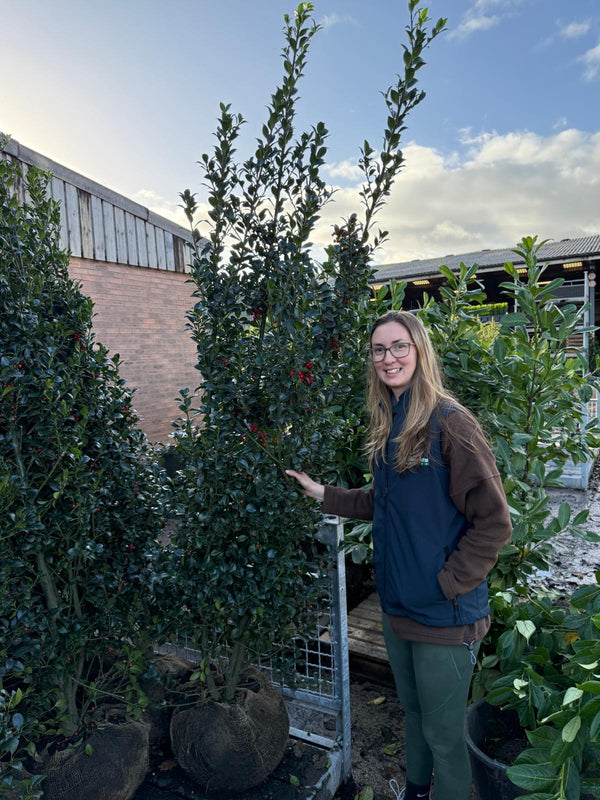

About Big Deal Ilex mes. Heckenfee 160/180cm Bushy Root Ball Delivery from October x 10
Ilex meserveae 'Heckenfee'
Bold, glossy, and reliably evergreen, Ilex meserveae 'Heckenfee' is a first-rate Blue Holly that brings year-round structure, rich foliage colour, and a spectacular winter display of bright red berries to the garden. A compact, bushy shrub with a naturally dense and rounded habit, 'Heckenfee' is one of the most garden-worthy of the Meserve hybrids — celebrated for its exceptionally deep, blue-green glossy leaves, often tinged with a distinctive purplish hue in winter that gives the whole group their evocative common name.
In spring, clusters of small white flowers appear among the foliage, providing a quiet but welcome early-season interest and attracting pollinators. On female plants such as 'Heckenfee', these are followed — provided a suitable male pollinator is nearby — by a generous crop of vivid scarlet berries that ripen and persist well into winter, bringing colour and life to the garden when little else can. The berries are enormously attractive to birds, making this an outstanding choice for wildlife-friendly planting schemes.
Hardy, resilient, and adaptable, Ilex meserveae 'Heckenfee' suits a wide variety of garden settings. It can be grown as a free-standing specimen, shaped into a formal hedge or screen, or used as part of a mixed evergreen planting to provide long-season structure and interest. Its tidy, self-disciplined habit and tolerance of clipping make it equally at home in formal and informal schemes alike.
Growing conditions
Position: Performs best in full sun to partial shade. A position with good light encourages the richest foliage colour, the most prolific flowering, and the heaviest berry set. 'Heckenfee' tolerates dappled or moderate shade well, remaining attractive and healthy even in less sunny aspects, though berry production may be reduced in deeper shade. Some shelter from cold, desiccating winds is beneficial, particularly for young plants establishing in their first season.
Soil: Prefers moist, well-drained, moderately fertile soil with a slightly acidic to neutral pH. Like most hollies, 'Heckenfee' performs best where the soil does not become waterlogged, but it will adapt to a range of conditions including heavier loams, provided drainage is reasonable. Incorporating organic matter into the planting hole helps retain moisture and supports establishment on lighter, free-draining soils.
Pollination: As a female cultivar, Ilex meserveae 'Heckenfee' requires a compatible male Blue Holly (such as Ilex meserveae 'Blue Prince' or a similar male Meserve hybrid) growing within reasonable proximity to set its berries. A single male plant will pollinate several nearby females. Without a male pollinator, flowers will not set fruit.
Hardiness: Fully hardy across the vast majority of the UK and much of northern Europe. The Meserve hybrids were specifically bred for cold-hardiness and 'Heckenfee' is no exception, shrugging off winter temperatures that would trouble less robust hollies. It tolerates urban conditions and is well suited to exposed or windswept positions once established.
Care
Watering: Water thoroughly and regularly in the weeks and months following planting to help the root system settle and establish. Once well rooted, 'Heckenfee' is a robust and reasonably drought-tolerant shrub, but it will benefit from supplementary watering during extended dry spells, particularly on lighter soils or in containers.
Feeding: Apply a balanced general-purpose or ericaceous fertiliser in spring to support healthy growth and maintain the depth and lustre of the foliage. An annual mulch of organic matter — such as bark, compost, or leaf mould — applied around the base of the plant in spring or autumn will help retain soil moisture, moderate root temperature through summer and winter, and gradually improve soil structure.
Pruning: 'Heckenfee' has a naturally neat and compact habit that requires relatively little intervention to keep it looking its best. Light shaping can be carried out in mid to late spring, once the risk of hard frosts has passed and any new growth has begun to emerge. If grown as a hedge or clipped form, a second light trim in late summer will keep the outline crisp and tidy through winter. Avoid heavy pruning in autumn, as this can expose tender new growth to early frosts. Always use sharp, clean tools when cutting to minimise damage to the spiny foliage and reduce the risk of disease entry.
Pests and disease: Ilex meserveae cultivars are generally healthy and trouble-free in garden conditions. 'Heckenfee' has good resistance to the common problems that affect other popular evergreen shrubs and is not susceptible to box blight, making it a reassuringly low-maintenance and long-lived addition to the garden. Watch for holly leaf miner in some seasons, which can cause blotchy discolouration to the leaves, though this is largely cosmetic and rarely affects the vigour or overall health of the plant.