

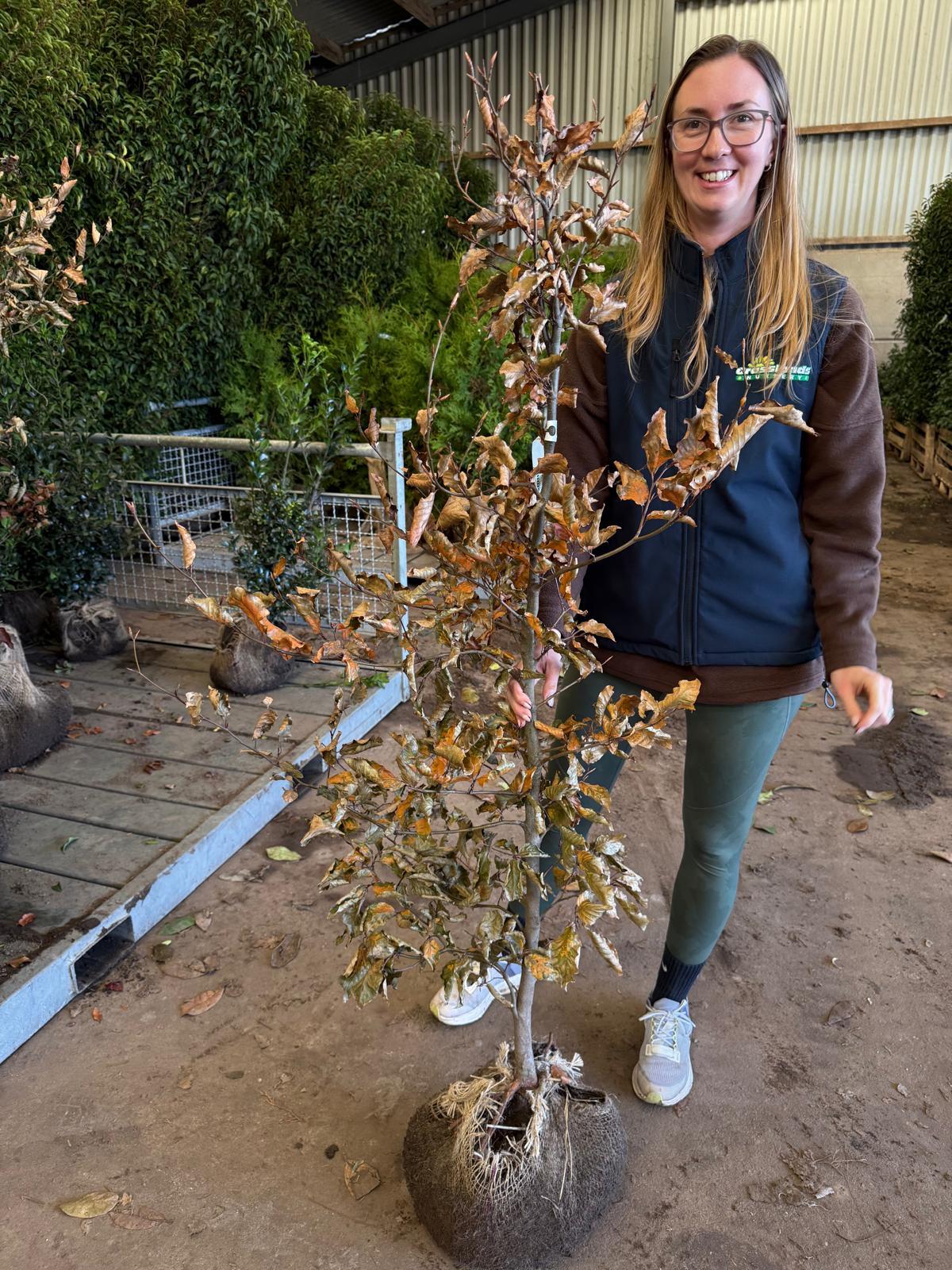

About Copper Beech 125-150cm Root Ball Delivery from October
Common Beech
A Majestic Native Tree with Outstanding Seasonal Interest
Common Beech (Fagus sylvatica) is one of Britain's most magnificent native trees, celebrated for its stately form, smooth silver-grey bark, and exceptional seasonal foliage. Fresh lime-green leaves emerge in spring, maturing to a lustrous mid-green through summer before turning warm shades of gold, amber, and russet in autumn. Even in winter the tree retains great presence, its elegant branching framework and pale bark providing strong structural interest in any landscape. Fully hardy and long-lived, Common Beech is a rewarding choice for parkland, large gardens, avenues, and naturalistic planting schemes alike.
Key Features
-
Foliage: Bright green in spring and summer, turning rich gold and amber in autumn
-
Bark: Distinctive smooth silver-grey, attractive year-round
-
Form: Broadly domed, upright when young, spreading with maturity
-
Wildlife Value: Excellent – mast (beechnuts) provides food for birds and small mammals
-
Hardiness: Fully hardy throughout the UK
Perfect For
-
Parkland, large gardens, and estate planting
-
Formal or informal avenues and specimen planting
-
Woodland and naturalistic planting schemes
-
Wildlife-friendly gardens and conservation areas
Growing Conditions
-
Position: Full sun to partial shade; sheltered from strong, cold winds where possible, particularly when young.
-
Soil: Prefers well-drained, fertile soil – chalky, sandy, or loamy soils all suit it well. Avoid heavy, poorly drained, or waterlogged ground, which can cause root stress and poor establishment.
-
Watering: Water regularly during the first growing season to encourage deep rooting. Once established, Common Beech is largely drought-tolerant.
Care & Pruning
-
Formative pruning: Remove any crossing, damaged, or poorly placed branches in late autumn or winter while the tree is dormant, to encourage a strong, balanced framework.
-
Ongoing maintenance: Established trees require very little pruning. Carry out any remedial work during the dormant season to minimise stress and disease risk.
-
Mulching: Apply a generous layer of organic mulch around the base each spring to retain moisture, suppress weeds, and feed the soil – keep mulch clear of the trunk itself.
-
Feeding: A balanced slow-release fertiliser applied in spring will support healthy growth during the early years of establishment.
Tip: Common Beech responds well to clipping and can also be trained as a formal hedge – trim in late summer to maintain a crisp outline and encourage dense foliage.
Why Choose Common Beech?
-
Outstanding four-season interest from spring foliage through to winter bark and structure
-
One of the UK's finest native trees – wildlife-friendly and ecologically valuable
-
Adaptable to a wide range of soils and conditions once established
-
Long-lived and low-maintenance, providing generations of enjoyment