

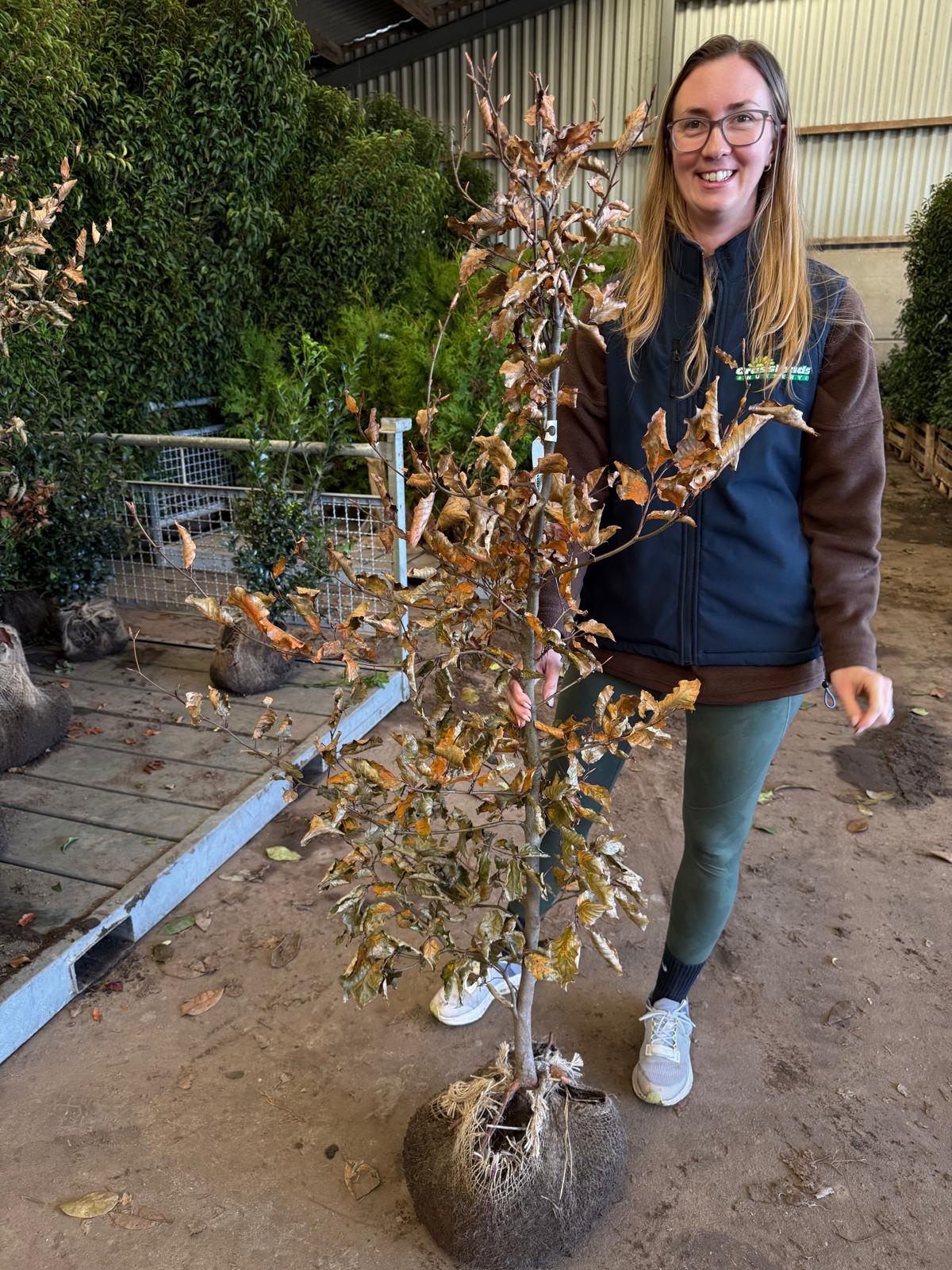

About Big Deal Copper Beech 125-150cm Root Ball x 20 Delivery from October
Fagus sylvatica 'Riversii' – Copper Beech
A Majestic Specimen Tree with Striking Deep Purple Foliage
Fagus sylvatica 'Riversii' is one of the finest and most richly coloured of all the copper beeches, prized for its exceptionally deep purple-black foliage that makes a bold, dramatic statement in any garden or landscape. One of the darkest-leaved forms available, 'Riversii' opens in spring with vivid crimson-purple growth that matures through summer to an intense, near-black purple. As autumn arrives, the canopy transitions to warm copper and bronze tones before the leaves fade and cling through winter, offering continued presence and seasonal interest long after other deciduous trees have shed. With a broad, domed crown and smooth silver-grey bark, this is a truly majestic tree built for the long term.
Key Features
-
Foliage: Exceptionally deep purple-black in summer, opening crimson-red in spring and turning copper-bronze in autumn
-
Form: Broad, domed crown with a strong, upright central leader; impressive spreading habit at maturity
-
Bark: Smooth, pale silver-grey — ornamental even in winter
-
Wildlife Value: Provides mast (beech nuts) for birds and small mammals; supports a wide range of insects
-
Hardiness: Fully hardy throughout the UK
-
Longevity: A long-lived, generational tree — a genuine landscape investment
Perfect For
-
Large gardens, parkland, and estate planting as a statement specimen
-
Creating dramatic focal points and canopy structure
-
Contrast planting alongside green-leaved trees and shrubs
-
Avenue planting and formal landscape schemes
-
Wildlife-friendly gardens and naturalistic settings
Growing Conditions
-
Position: Full sun to partial shade — foliage colour is richest and darkest in an open, sunny position
-
Soil: Fertile, well-drained soil; performs well on chalk, loam, and sandy soils — avoid heavy, waterlogged ground
-
Shelter: Reasonably tolerant of exposure once established, though young trees benefit from some protection from strong winds
-
Spacing: Allow generous space for the crown to develop fully — this tree is not suited to confined urban plots
Care & Pruning
-
Watering: Water thoroughly and regularly through the first growing season until fully established; mature trees are largely drought-tolerant
-
Mulching: Apply a generous mulch of bark or compost around the base after planting to retain moisture and suppress weeds — keep mulch clear of the trunk
-
Pruning: Minimal pruning is required for a free-growing specimen. Remove any dead, damaged, or crossing branches in late winter while the tree is dormant. Formative pruning to develop a clear central leader can be carried out in the early years if needed
-
Feeding: A balanced slow-release fertiliser applied in spring will support establishment and encourage healthy growth
Tip: Avoid pruning in spring when the sap is rising, as beech can bleed heavily. Late winter or mid-summer are the best times to carry out any necessary work.