

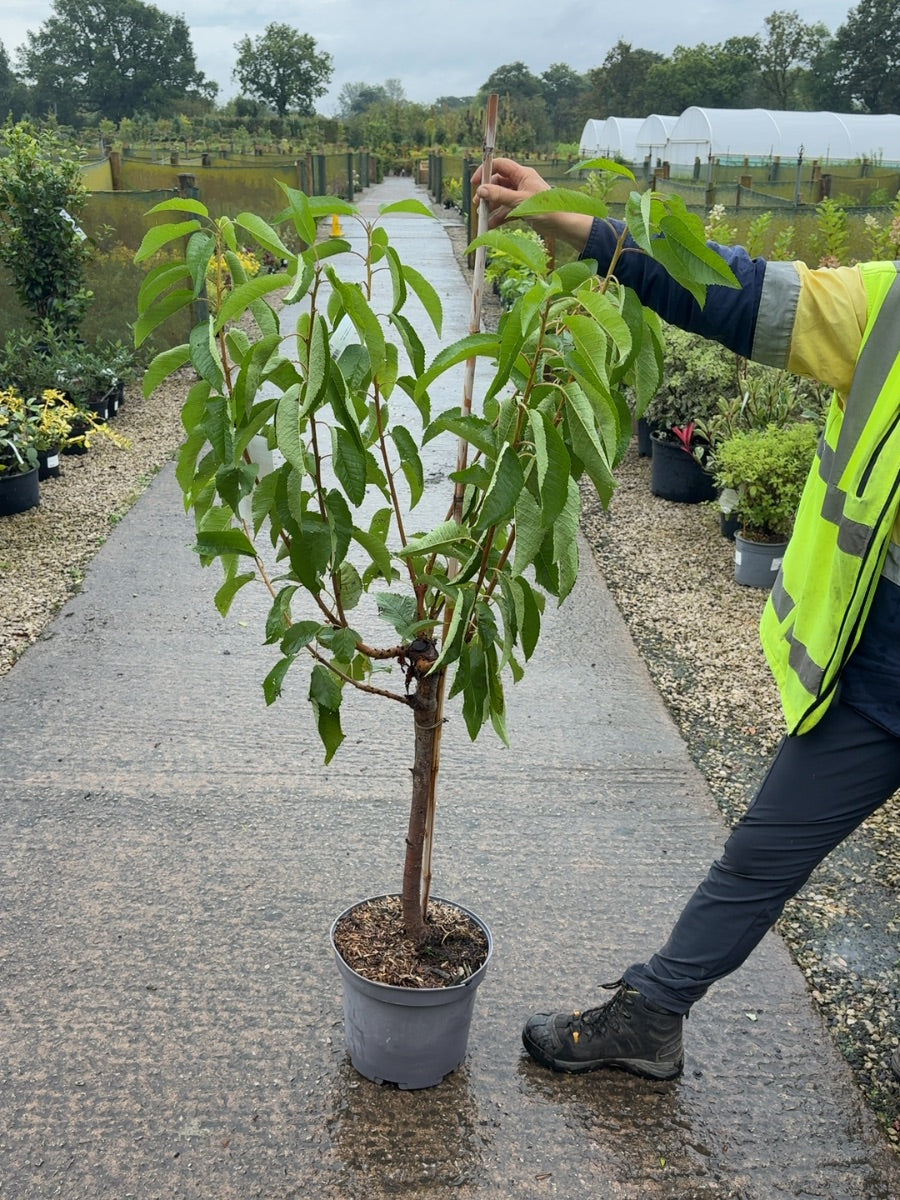
About Cherry Hatif De Burlap 10 Litre Pot Goblet
Cherry 'Hatif de Burlat' (Prunus avium 'Hatif de Burlat') – A Classic Early-Season Sweet Cherry for Garden and Orchard
Prunus avium 'Hatif de Burlat' is one of the most celebrated early-ripening sweet cherries available, prized by growers for its generous crops of large, deep red fruits that arrive ahead of most other varieties. Originating in France, 'Hatif de Burlat' has earned a loyal following across Europe for combining outstanding fruit quality with reliable cropping and an attractive, ornamental character that makes it as beautiful in blossom as it is productive at harvest time.
As a garden tree, it is as rewarding to grow as it is to eat from. In spring, the canopy erupts in a cloud of white blossom that is both a delight to the eye and a magnet for early pollinators. By early summer — typically among the first cherries to ripen — it yields glossy, heart-shaped fruits with sweet, richly flavoured flesh. Whether grown as a free-standing specimen, trained against a wall, or on a dwarfing rootstock in a smaller garden, 'Hatif de Burlat' is a worthy centrepiece of any productive planting scheme.
Key Features
One of the earliest sweet cherries to ripen — typically ready to harvest in late June
Large, deep red, heart-shaped fruits with sweet, richly flavoured flesh
Spectacular white blossom in spring, highly attractive to bees and other pollinators
Vigorous, upright-spreading habit with good ornamental appeal throughout the seasons
Suits a range of garden sizes depending on rootstock selection
Growing Conditions
Position: 'Hatif de Burlat' performs best in a warm, sheltered spot in full sun. A south- or south-west-facing aspect is ideal, particularly in cooler or wetter climates where maximising warmth and light will improve fruit set and ripening. Avoid exposed, frost-prone positions, as the early blossom is vulnerable to late spring frosts — a sheltered wall or fence can offer valuable protection.
Soil: This cherry prefers a deep, fertile, well-drained loam. It will tolerate a range of soil types provided they are not waterlogged or excessively shallow, as cherries are sensitive to poor drainage and compacted roots. Slightly alkaline to neutral soils are generally well suited. Avoid heavy clay without first improving drainage, and steer clear of very sandy soils that dry out rapidly in summer.
Hardiness: Fully hardy throughout the UK and most of Northern Europe, though the early blossom benefits from shelter against late frosts. The tree itself is robust once established and tolerates cold winters without difficulty.
Habit & Appearance
Form: 'Hatif de Burlat' develops a vigorous, upright to broadly spreading habit, forming a well-structured canopy that becomes increasingly characterful with age. The tree has a classic, open-grown cherry silhouette that provides strong seasonal interest from the first flush of spring blossom through to autumn leaf colour.
Blossom: In mid-spring, the bare branches are clothed in clusters of pure white, five-petalled flowers — an outstanding ornamental display that typically precedes the emergence of the leaves. The blossom is not only beautiful but also an important early nectar source for bees and other beneficial insects.
Foliage & Autumn Colour: The leaves are mid- to deep green throughout summer, broadly oval with a serrated edge, and turn warm shades of orange, gold, and red in autumn before falling. The overall seasonal progression from blossom to leafing, fruiting, and autumn colour makes this a genuinely four-season tree.
Fruit: The cherries are large, glossy, and deep crimson to mahogany-red when fully ripe. The flesh is firm yet juicy, sweet and full-flavoured — ideal for eating fresh straight from the tree, as well as for cooking, preserving, and making cherry liqueur or jam.
Pollination: 'Hatif de Burlat' is self-fertile, meaning it will set a crop without a pollination partner — a significant advantage in smaller gardens. However, yields are often improved in the presence of another compatible sweet cherry flowering at a similar time.
Care & Pruning
Watering: Water regularly during the first two growing seasons to establish a strong, deep root system. Once settled, the tree is reasonably drought-tolerant in average conditions, though irrigation during dry spells in early summer — when the fruit is swelling — will significantly improve crop size and quality. Avoid irregular watering at this stage, as fluctuating moisture levels can cause fruit to split.
Feeding: Apply a balanced fertiliser or a dedicated fruit tree feed in early spring as growth begins. A mulch of well-rotted organic matter around the base each year helps retain moisture, suppress weeds, and gradually improve soil fertility. Avoid over-feeding with high-nitrogen products, which can encourage excessive leafy growth at the expense of fruiting.
Pruning: Sweet cherries should be pruned during the growing season — ideally in late spring or summer — rather than in winter, to minimise the risk of silver leaf and bacterial canker,
Plants well with
Our growers' picks to plant alongside Cherry Hatif De Burlap 10 Litre Pot Goblet for a fuller, longer-lasting display.
-
Amelanchier aln. Obelisk 12 Litre Pot 100/125cm
Amelanchier alnifolia 'Obelisk'Full sunDeciduousPre-orderRegular price £55.50Regular price -
Magnolia Black Tulip 20 Litre Pot 150/175cm
Magnolia Black Tulip ('Jurmag1')Full sunDeciduousGetting lowRegular price £193.50Regular price -
Geranium Johnson's Blue 2 Litre Pot
Geranium × johnsonii 'Johnson's Blue'Full sunDeciduousGetting lowRegular price £4.60Regular price


