


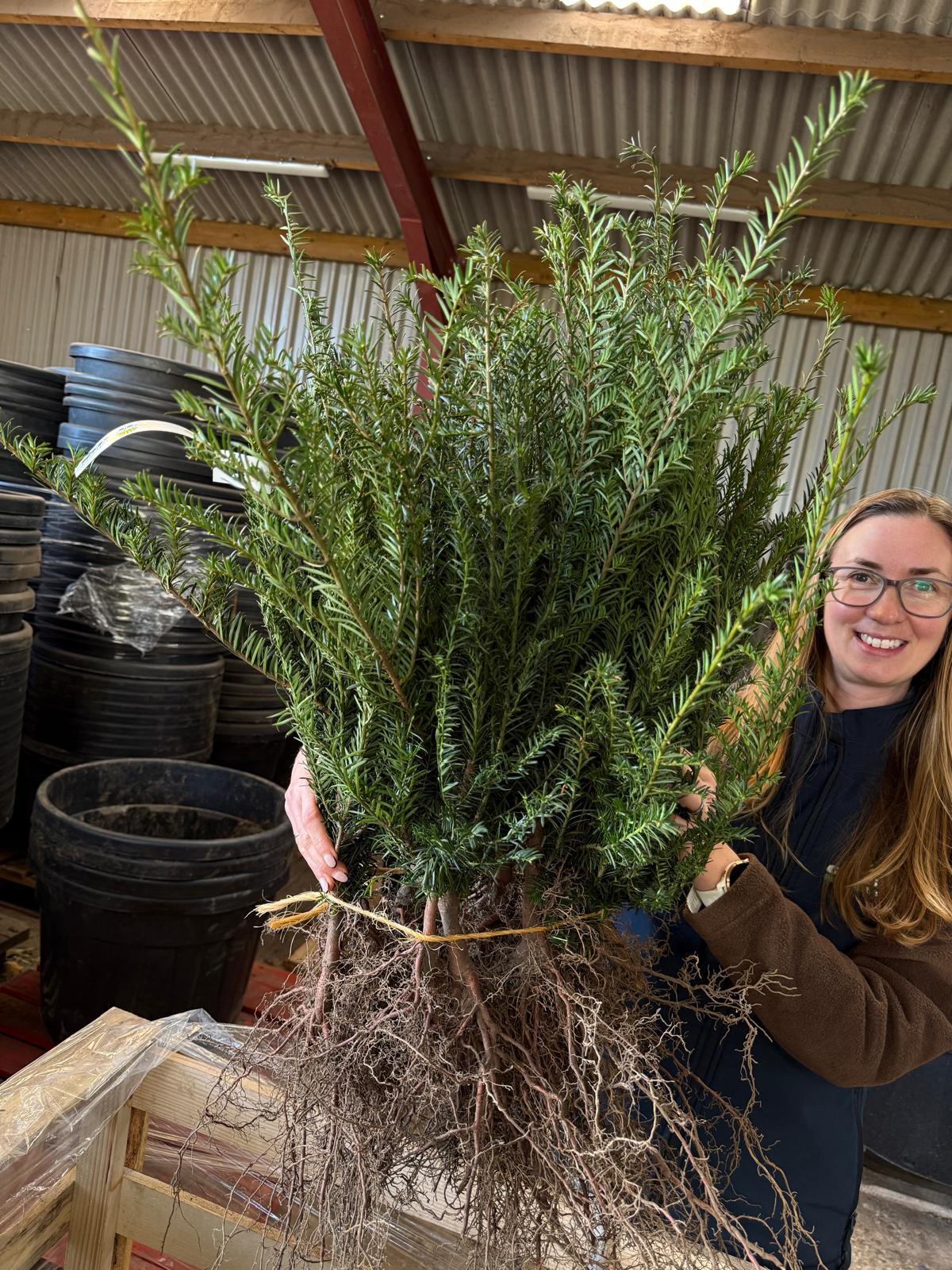

About Big Deal Yew Hedging Bare Root 50/70cm x 200 Delivery from November
Taxus baccata – English Yew, a Timeless Evergreen for Structure, Privacy and Wildlife
Taxus baccata, the English Yew, is one of Britain's most ancient and celebrated native evergreens, prized for its exceptionally dense, dark green foliage, remarkable longevity and unrivalled versatility across a wide range of garden settings. Whether grown as a majestic free-standing specimen, a tightly clipped formal hedge or an intricate topiary sculpture, English Yew brings enduring elegance and year-round structure to any landscape. Slow-growing and incredibly long-lived, it is a plant that truly rewards patience, maturing into a refined and stately presence capable of defining a garden for generations to come.
Beyond its considerable ornamental qualities, Taxus baccata offers genuine value for wildlife. Female plants produce distinctive bright red arils in autumn — jewel-like berries eagerly sought by thrushes, blackbirds and other garden birds — while the plant's dense evergreen canopy provides excellent shelter and nesting habitat throughout the year. It is important to note that all parts of the plant, with the exception of the fleshy aril itself, are toxic if ingested by humans, livestock and pets, and due care should be taken in gardens accessible to children or animals.
Habit & Appearance
Form and foliage. English Yew develops a naturally upright to broadly conical habit in youth, becoming more rounded and wide-spreading with age. The foliage is composed of flat, linear needles arranged in two ranks along the shoots, deep glossy green on the upper surface and paler beneath. Fresh growth emerging in spring carries a softer, lighter green tone that contrasts beautifully with the mature dark needles, adding subtle seasonal interest to an otherwise consistent plant. The bark is reddish-brown and naturally flaking, lending attractive textural character to established specimens.
Seasonal highlights. Spring brings a welcome flush of bright new foliage growth, lightening the plant's typically sombre, deep tones. Through summer the canopy remains dense, lush and richly coloured, providing a superb neutral backdrop to flowering plants in mixed borders. Autumn sees female plants adorned with their distinctive scarlet berries — a striking ornamental feature and an important seasonal food source for birds. Through winter, the fully evergreen foliage retains its colour and structure in its entirety, making Yew an invaluable anchor of permanence in the garden when many surrounding plants have retreated.
Growing Conditions
Position. Taxus baccata is exceptionally adaptable in terms of light, performing well in full sun through to deep shade. It is one of very few plants capable of producing a dense, healthy and well-furnished hedge in heavily shaded conditions, making it an outstanding choice for north-facing aspects, walled gardens and areas beneath the canopy of larger trees. Fully hardy throughout the UK, it withstands hard winters without damage and is untroubled by exposed or coastal conditions once established.
Soil. English Yew grows well in a wide range of soil types, including clay, loam, chalk and sandy soils, provided drainage is reasonably good. It has a well-documented dislike of prolonged waterlogging, which can lead to root problems over time, so on heavy or poorly drained ground it benefits from the incorporation of horticultural grit or organic matter at planting. It is notably tolerant of alkaline conditions and performs admirably on thin chalk soils where many other plants struggle to establish.
Establishment. Young plants establish most reliably when planted in autumn or early spring. Water regularly through the first growing season, particularly during dry spells, to encourage strong and deep root development. Once properly established, Taxus baccata is notably drought-tolerant and largely self-sufficient, requiring very little ongoing intervention to thrive.
Care & Pruning
Pruning and shaping. One of Yew's most valuable practical qualities is its exceptional tolerance of clipping and its remarkable ability to regenerate vigorously from old, hard wood — a characteristic that sets it firmly apart from the majority of other conifers. For hedging purposes, trim once or twice a year, ideally in late summer or early autumn, to maintain a crisp, formal outline and encourage the dense, twiggy interior growth that makes for a truly impenetrable screen. Topiary specimens can be shaped at the same time, with more intricate or detailed forms benefiting from a light additional tidy in late spring to keep definition sharp through the growing season.
Feeding and mulching. Although Taxus baccata is not a particularly hungry plant, an annual application of a balanced slow-release fertiliser in spring will support healthy, steady growth. Applying a mulch of well-rotted garden compost or composted bark around the base each year helps to retain soil moisture, suppress competing weeds and gradually improve soil structure — particularly beneficial during the first few years following planting while the root system is still developing.
General maintenance. Once well established, English Yew is a remarkably low-maintenance plant in all respects. It requires no deadheading, rarely suffers from serious pest or disease problems and needs no winter protection in typical UK conditions. Occasional removal of any dead or damaged shoots in spring is generally all that is required outside of the regular pruning regime, making it one of the most rewarding long-term investments available to the garden maker.
Garden Uses
Hedging and screening. Taxus baccata is widely and consistently regarded as the finest hedging plant available for formal garden settings, producing hedges of unmatched density, depth and longevity. It creates a highly effective visual and physical barrier and, once well established, provides excellent wind shelter, noise attenuation and a rich, dark
Plants well with
Our growers' picks to plant alongside Big Deal Yew Hedging Bare Root 50/70cm x 200 Delivery from November for a fuller, longer-lasting display.
-
Carpinus betulus Fastigiata - Hornbeam Tree 5 Litre Pot
Carpinus betulusFull sunDeciduousIn stockRegular price £12.00Regular price
