
Rootball pre-order discount ends soon
Reserve rootball hedging now at pre-order prices — dug fresh and delivered when the season starts in October.


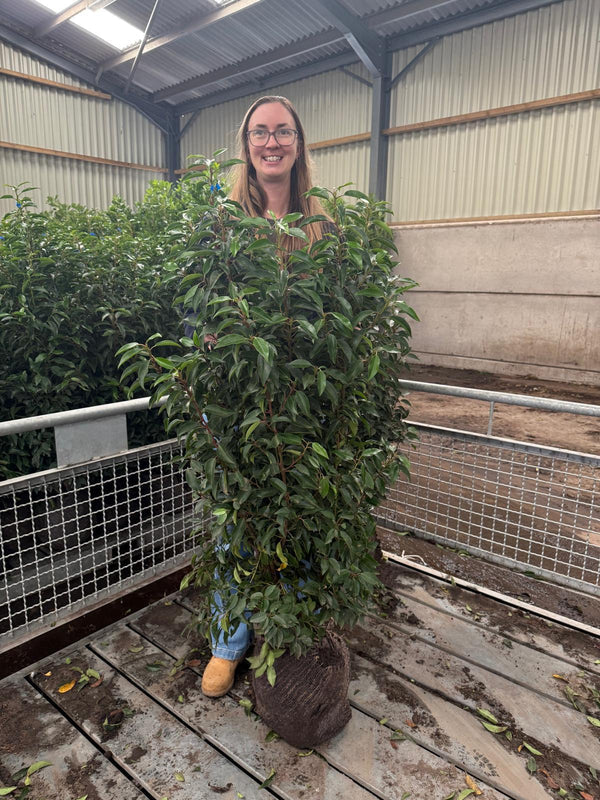
Big Deal Portuguese Laurel Hedging 120/140cm Root Ball x 20
Big Deal Portuguese Laurel Hedging 120/140cm Root Ball x 20

Couldn't load pickup availability
Order now to reserve your plants at today's price. We'll email you with a delivery date as soon as they're ready to dispatch.


About Big Deal Portuguese Laurel Hedging 120/140cm Root Ball x 20
Portuguese Laurel (Prunus lusitanica) – Refined, Hardy Evergreen for Hedging, Screening & Specimen Planting
Prunus lusitanica, universally known as Portuguese Laurel, stands among the most elegant and dependable evergreen shrubs and small trees available to UK gardeners. Its deep, lustrous dark green leaves, carried on distinctive crimson-red stalks, give it an immediately distinguished appearance that sets it well apart from coarser-leaved relatives. Dense, shapely, and remarkably adaptable, it performs with equal poise as a clipped formal hedge, a precisely shaped topiary specimen, a tall privacy screen, or a graceful free-standing tree.
More moderate in pace than Cherry Laurel, Portuguese Laurel builds into a plant of real quality and permanence. In early summer it produces long, slender racemes of small, sweetly scented creamy-white flowers that draw pollinators in numbers. These are followed by elegant chains of small fruits, ripening from bright red through to deep purple-black in autumn — a handsome display and a welcome resource for garden birds. Fully hardy, long-lived, and tolerant of a surprisingly wide range of conditions, this is a plant that rewards investment and only improves with age.
Key Features
Distinguished evergreen foliage — deep, polished dark green leaves on striking red petioles
Outstanding for formal hedging, topiary, tall screening, or multi-stemmed specimen planting
Fragrant white flower racemes in early summer, followed by colourful wildlife-friendly fruits
Fully hardy and tolerant of exposed, coastal, chalk, and urban conditions
More refined and manageable in growth than Cherry Laurel — a first choice for quality garden settings
Growing Conditions
Position: Prunus lusitanica thrives in full sun or partial shade and shows a strong tolerance of exposed, windy, and coastal positions that few evergreens match. It makes an excellent boundary or windbreak plant in open or seaside gardens. It will also grow acceptably on north-facing aspects, though in deep shade the habit may become more open and growth somewhat slower.
Soil: Adaptable across a broad range of soil types — including chalk, clay, loam, and sandy soils — provided drainage is reasonably good. It settles readily into moist, fertile ground but copes well with drier conditions once properly established. Avoid sites that are persistently waterlogged, as poor drainage may lead to root problems over time.
Hardiness: Fully hardy throughout the UK, including more northerly, upland, and exposed locations. Portuguese Laurel demonstrates excellent cold resilience and holds its foliage well through hard winters, maintaining its ornamental value year-round.
Habit & Appearance
Foliage: Leaves are oval, pointed, and notably smaller and more refined than those of Cherry Laurel — a deep, glossy dark green above, paler beneath, and borne on eye-catching red to crimson petioles that provide a subtle but year-round colour accent. The foliage is dense and well-held, giving clipped plants a crisp, precise finish that makes them particularly valued for formal work.
Flowers & Fruit: In early to midsummer, mature plants carry graceful, slender racemes of small creamy-white flowers with a soft, pleasant fragrance attractive to bees and other pollinators. Flowering is followed by pendant chains of small oval fruits, transitioning from vivid red to deep purple-black through autumn — an attractive display that is eagerly exploited by blackbirds, thrushes, and other garden birds.
Ultimate Size: Left to grow freely, Portuguese Laurel will develop into a large multi-stemmed shrub or small tree of 6–10m, forming a naturally rounded, handsome crown over time. Typical growth rates are 20–40cm per year — appreciably more moderate than Cherry Laurel — making it inherently easier to manage and keep to a chosen size with only occasional attention.
Care & Pruning
Watering: Water consistently throughout the first growing season to support strong root establishment. Once settled, Portuguese Laurel is notably drought-tolerant and largely self-sufficient under typical UK rainfall. During extended dry periods, newly planted specimens will benefit from additional watering until fully established.
Feeding: A balanced general-purpose fertiliser applied in early spring will encourage healthy, robust growth, especially in poorer or leaner soils. An annual mulch of well-rotted organic matter around the base helps retain soil moisture, suppress weeds, and gradually improve fertility — particularly beneficial in the first few years after planting.
Pruning: For hedging or shaped topiary specimens, trim once a year in late summer to maintain a clean, dense outline. Where a particularly tight or formal finish is required, a lighter pass with secateurs in late spring — after any new growth has hardened — gives an excellent result. Portuguese Laurel clips cleanly and holds its shape with exceptional precision, making it among the best species available for formal topiary work. When grown as a free-standing shrub or specimen tree, minimal intervention is needed: simply remove any dead, damaged, or crossing branches in late spring to keep the framework open, balanced, and tidy.
Pests & Disease: Generally healthy and notably trouble-free, with good natural resistance to the fungal diseases that occasionally affect other laurel species. Aphids
Plants well with
Our growers' picks to plant alongside Big Deal Portuguese Laurel Hedging 120/140cm Root Ball x 20 for a fuller, longer-lasting display.
-
Amelanchier aln. Obelisk 12 Litre Pot 100/125cm
Amelanchier alnifolia 'Obelisk'Full sunDeciduousIn stockRegular price £55.50Regular price -
Magnolia Black Tulip 20 Litre Pot 150/175cm
Magnolia Black Tulip ('Jurmag1')Full sunDeciduousGetting lowRegular price £193.50Regular price

