

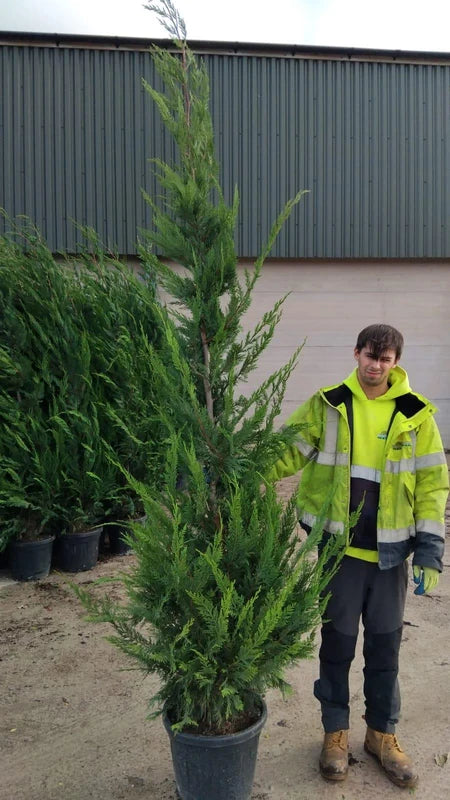

About Big Deal Green Leylandii 2.70 - 3 Metre x 20 Pot Grown
× Cuprocyparis leylandii – Leyland Cypress | Fast-Growing Evergreen Conifer for Hedging, Screening & Windbreaks
The Leyland cypress (× Cuprocyparis leylandii) is one of Britain's most widely planted and instantly recognisable conifers, valued above all for its extraordinary vigour, dense evergreen foliage and remarkable versatility. A hybrid between Cupressus macrocarpa and Chamaecyparis nootkatensis, it combines the best qualities of both parents to produce a tree of outstanding constitution – tolerant of a wide range of soils and climates, unfazed by coastal winds, and reliably hardy throughout the UK.
Whether used as a formal clipped hedge, a tall privacy screen, a robust windbreak, or an architectural specimen, the Leyland cypress delivers results faster than almost any other evergreen. Its flat, feathery sprays of rich green foliage form a dense, continuous mass that remains lush and vibrant in all four seasons, providing year-round privacy, shelter and structure wherever it is planted.
Habit & Appearance
Vigorous, upright and densely clothed. × Cuprocyparis leylandii develops a strongly columnar to broadly conical habit, with tightly packed, scale-like foliage carried on flattened, arching sprays. The growth is rapid – commonly 60–90 cm per year under good conditions – and the branching is naturally dense from the base upwards, which is precisely what makes it so effective as a hedge or screen. Left unpruned as a free-growing specimen, it eventually forms a tall, stately tree with a softly tapering silhouette. The foliage is a consistent deep green with a slightly grey-green reverse, giving hedges a full, uniform texture and a pleasing, formal appearance.
Growing Conditions
Highly adaptable and tolerant of challenging sites. Leyland cypress performs best in full sun but will grow well in partial shade, making it useful in a wider range of garden aspects than many conifers. It is at home in most well-drained soils – including clay, loam, chalk and sandy soils – and shows good tolerance of both acid and mildly alkaline conditions. It is notably wind-resistant, making it an excellent choice for exposed gardens, coastal plots and open rural sites where shelter is needed quickly. Avoid planting in permanently waterlogged or poorly drained ground, as prolonged standing water around the roots can cause stress and decline.
Hardiness: Fully hardy throughout the UK, tolerating temperatures well below freezing without damage to foliage or structure.
Planting
Plant with care and give a good start. For hedging, plant in a single row with spacing of approximately 60–90 cm between plants, depending on the size of specimens used and the speed of establishment required. Prepare the ground well before planting, breaking up compacted soil and incorporating organic matter to encourage strong early root development. Water thoroughly at planting and continue to water regularly throughout the first growing season, particularly during dry spells. Once established, Leyland cypress is largely self-sufficient and very drought-tolerant, but consistent watering in the first year makes a significant difference to early growth rates. Apply a balanced slow-release fertiliser in spring to support vigorous establishment.
Care & Pruning
Regular trimming keeps Leyland cypress at its best. For a formal hedge or screen, trim two to three times during the growing season – typically between April and September – to maintain density, control height, and encourage a tight, even surface. The more frequently it is clipped when young, the thicker and more impenetrable the hedge becomes over time. Always cut into the current season's green growth; Leyland cypress does not regenerate reliably from old brown wood, so avoid cutting back hard into areas where foliage has already been lost. For a more informal or natural appearance, a single annual trim in late summer is generally sufficient to keep the plant tidy and well proportioned.
Tip: Begin trimming young plants early in their life to build a dense framework from the base. A hedge clipped regularly from the outset will be far fuller and more effective than one left to grow unchecked and trimmed hard later.
Perfect Uses
A plant for many purposes. Leyland cypress excels as a boundary hedge for privacy and screening, a windbreak for exposed or coastal gardens, a noise-reducing barrier alongside busy roads, and a robust green backdrop to mixed borders or formal planting schemes. It can also be grown as a free-standing specimen tree in larger spaces, where its naturally elegant, columnar outline makes a bold architectural statement. Underplant the base of established hedges with shade-tolerant perennials such as ferns, hellebores or hardy geraniums for a layered, finished look.
Looks Great With
Versatile in combination. The rich, neutral green of Leyland cypress provides an excellent foil for brighter or more colourful planting. Pair with golden-foliaged conifers such as Chamaecyparis lawsoniana 'Lane' or a golden Leylandii cultivar for striking contrast in a mixed hedge. Combine with photinia, laurel or hornbeam for a varied boundary planting that adds textural interest. In the wider garden, it works beautifully as a backdrop to roses, ornamental grasses, and flowering shrubs, anchoring the planting scheme and giving it year-round depth and structure.