
-
Hawthorn Hedging Bare Root 40-60 cm Delivery from November
Crataegus monogynaFull sunDeciduousIn stockRegular price £1.21Regular price£1.35Sale price £1.21Sale -
Hazel Hedging Bare Root 100-120 cm Delivery from November
Corylus avellanaFull sunDeciduousIn stockRegular price £1.57Regular price£1.75Sale price £1.57Sale -
Ilex Aquifolium Hedging 40/60cm Bare Root Delivery from November
Ilex aquifoliumFull sunEvergreenIn stockRegular price £2.88Regular price£3.20Sale price £2.88Sale -
Blackthorn Hedging Bare Root 60-100 cm Delivery from November
Prunus spinosaFull sunDeciduousIn stockRegular price £1.75Regular price£1.95Sale price £1.75Sale -
Guelder Rose Hedging Bare Root 60-100 cm Delivery from November
Viburnum opulusFull sunDeciduousIn stockRegular price £1.44Regular price£1.60Sale price £1.44Sale -
Rosa Rugosa Hedging Bare Root 40-60 cm Delivery from November
Rosa rugosaFull sunDeciduousIn stockRegular price £1.70Regular price£1.90Sale price £1.70Sale -
Spindle (euonymus) Hedging Bare Root 60-100 cm Delivery from November
Euonymus europaeusFull sunDeciduousIn stockRegular price £2.15Regular price£2.40Sale price £2.15Sale -
Dogwood Hedging Bare Root 60-100 cm Delivery from November
Cornus sanguineaFull sunDeciduousIn stockRegular price £1.44Regular price£1.60Sale price £1.44Sale -
Field Maple Hedging Bare Root 40/60 cm Delivery from November
Acer campestreFull sunDeciduousIn stockRegular price £1.75Regular price£2.10Sale price £1.75Sale -
Rosa Canina Hedging Bare Root 40-60 cm Delivery from November
Rosa caninaFull sunDeciduousIn stockRegular price £1.70Regular price£1.90Sale price £1.70Sale


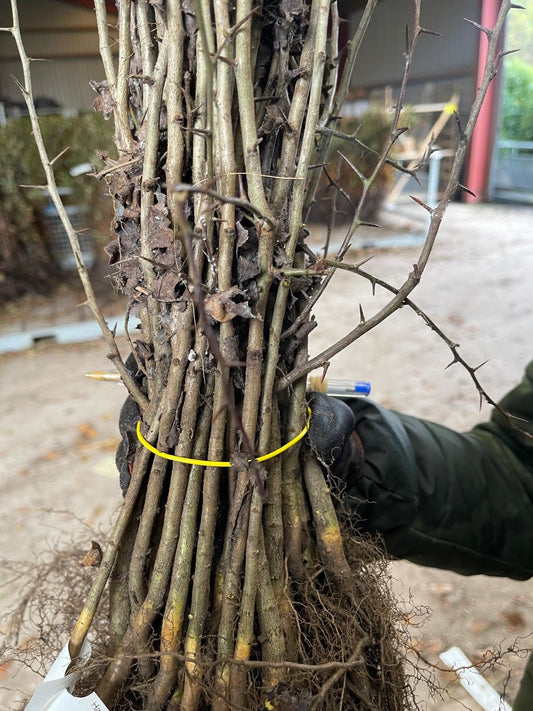

Native Hedging – 2026 Pre-Orders Now Open
Traditional British Hedging – Available November to March
Native hedging is the perfect choice for creating natural boundaries, wildlife-friendly gardens, rural landscapes and traditional country hedges.
Our range includes some of Britain’s best-known hedging plants, including Hawthorn, Blackthorn, Dogwood, Spindle, Guelder Rose, Dog Rose, Rosa rugosa, Holly and Field Maple. These plants can be used individually or combined to create a varied mixed native hedge with seasonal colour, flowers, berries and valuable shelter for wildlife.
Our bare root native hedging is field-grown and lifted during the dormant season without pots or soil around the roots. This makes it lightweight, easy to plant and one of the most economical ways to establish a long-lasting hedge.
Available exclusively from November to March, native bare root hedging is ideal for domestic gardens, farms, estates, paddocks, woodland edges and large landscaping projects.
Why Pre-Order Your Native Hedging?
Our native hedging plants are lifted fresh from the field during the dormant season, with the widest choice of varieties, sizes and quantities available from the first lifting of the season.
By pre-ordering now, you’ll benefit from:
✔ Priority access to freshly lifted field-grown plants
✔ The widest choice of native species and sizes
✔ Better availability for larger planting projects
✔ Priority dispatch once lifting begins
✔ Exclusive pre-order offers before the season starts
Bare root native hedging is available for only a limited period each year, and popular varieties and larger quantities can sell out early.
Why Choose Native Hedging?
Native hedging creates an attractive, natural boundary while providing valuable food, shelter and nesting opportunities for birds, insects and other garden wildlife.
It is particularly well suited to rural and countryside planting but can also be used to create informal boundaries and wildlife areas within domestic gardens.
Benefits include:
- Excellent value for money
- Fresh field-grown plants
- Ideal for long hedge lines
- Excellent wildlife value
- Seasonal flowers, berries and autumn colour
- Suitable for mixed-species planting
- Lightweight and easy to handle
- Reliable winter establishment
- Minimal packaging and no plastic pots
- Suitable for domestic and commercial projects
With correct planting and aftercare, native hedging will establish into a strong, dense and long-lasting boundary.
Our Native Hedging Varieties
Hawthorn – Crataegus monogyna
Hawthorn is one of Britain’s most traditional native hedging plants. It develops into a dense, thorny hedge with fresh green foliage, masses of white blossom during spring and red berries in autumn.
Its dense growth provides excellent shelter and nesting cover for birds.
Ideal for:
- Rural boundaries
- Stock-proof hedging
- Wildlife gardens
- Farms and paddocks
- Mixed native hedges
Blackthorn – Prunus spinosa
Blackthorn is a tough native hedging plant known for its dense, thorny growth. Small white flowers appear on the bare branches in early spring, followed by dark purple sloes in autumn.
It is particularly useful for creating secure, wildlife-friendly boundaries.
Perfect for:
- Rural hedging
- Secure boundaries
- Wildlife planting
- Exposed locations
- Mixed native hedges
Dogwood – Cornus sanguinea
Native Dogwood is valued for its attractive green foliage, clusters of small flowers and colourful autumn leaves. Its bare stems can also provide attractive winter interest.
Dogwood works especially well as part of a mixed native hedge, adding colour, texture and seasonal variation.
Ideal for:
- Mixed native planting
- Wildlife hedges
- Informal boundaries
- Woodland edges
- Seasonal colour
Spindle – Euonymus europaeus
Spindle is an attractive native shrub with green summer foliage that develops vivid red and orange tones during autumn.
Its distinctive pink and orange fruits provide additional seasonal interest and make it a valuable addition to mixed native hedging.
Perfect for:
- Wildlife-friendly gardens
- Mixed country hedges
- Informal boundaries
- Autumn colour
- Woodland planting
Guelder Rose – Viburnum opulus
Guelder Rose is a beautiful native hedging plant with clusters of white flowers during late spring and early summer.
Bright red berries follow during autumn, alongside rich autumn foliage. It is an excellent choice for adding flowers, fruit and seasonal colour to a mixed native hedge.
Ideal for:
- Wildlife gardens
- Mixed native hedging
- Moist but well-drained soils
- Informal boundaries
- Seasonal interest
Dog Rose – Rosa canina
Dog Rose is a vigorous native wild rose that produces delicate pink or white flowers during summer, followed by bright red hips in autumn.
Its scrambling, thorny growth helps create a dense and secure hedge while providing food and shelter for wildlife.
Perfect for:
- Traditional country hedges
- Wildlife planting
- Mixed native hedging
- Rural boundaries
- Informal gardens
Rosa rugosa
Rosa rugosa is a tough, reliable hedging rose with strongly scented pink or white flowers throughout summer.
Large red hips develop later in the season, providing autumn interest and a valuable food source for wildlife. Its dense, thorny habit makes it particularly useful for creating secure boundaries.
Ideal for:
- Coastal gardens
- Exposed locations
- Wildlife-friendly hedges
- Secure boundaries
- Informal flowering hedges
Holly – Ilex aquifolium
Native Holly is a traditional evergreen hedging plant with glossy, deep green leaves and dense growth.
Female plants may produce bright red berries where suitable pollination is available. Holly provides valuable year-round shelter for birds and gives a mixed native hedge evergreen structure and winter privacy.
Perfect for:
- Evergreen screening
- Wildlife gardens
- Shaded locations
- Mixed native hedges
- Traditional boundaries
Field Maple – Acer campestre
Field Maple is Britain’s only native maple and is a dependable choice for mixed country hedging.
Its attractive lobed leaves are fresh green during spring and summer before turning yellow and golden during autumn. It tolerates regular clipping and develops into a dense, well-branched hedge.
Ideal for:
- Mixed native hedging
- Rural landscapes
- Wildlife planting
- Traditional boundaries
- Autumn colour
Creating a Mixed Native Hedge
A mixed native hedge combines several complementary species to create a varied, natural-looking boundary.
Combining flowering, fruiting, thorny, deciduous and evergreen varieties provides interest throughout the year while supporting a wider range of wildlife.
A mixed native hedge may include:
- Hawthorn for dense structure
- Blackthorn for security and early flowers
- Dogwood for colourful stems and foliage
- Spindle for autumn colour and distinctive fruit
- Guelder Rose for flowers and berries
- Rosa canina for wild flowers and hips
- Rosa rugosa for scented flowers and dense growth
- Holly for evergreen cover
- Field Maple for structure and autumn colour
The final mixture can be adapted to suit the planting location, soil conditions and desired appearance.
Planting Native Bare Root Hedging
Bare root native hedging should be planted as soon as possible after delivery.
1. Protect the Roots
Never allow bare roots to dry out.
Keep them covered, cool and protected from wind and direct sunlight until you are ready to plant.
If planting must be delayed, temporarily heel the plants into loose soil or keep the roots wrapped in damp material.
2. Prepare the Ground
Remove grass, weeds and other vegetation from the planting area.
Dig a trench or individual planting holes wide enough to spread the roots naturally. Loosen compacted soil around the planting area to encourage healthy root development.
3. Plant at the Correct Depth
Plant each hedge plant at the same depth it was previously growing in the field. A change in colour or soil mark may be visible around the lower stem.
Spread the roots naturally and avoid bending them upwards or forcing them into a hole that is too small.
4. Backfill and Firm
Refill around the roots using the excavated soil.
Firm gently to remove large air pockets while avoiding excessive compaction around the root system.
5. Water Thoroughly
Water well immediately after planting to settle the soil around the roots.
Continue watering during dry periods throughout the first spring and summer.
Planting Distances
The number of native hedge plants required will depend on the size of the plants and how quickly you would like the hedge to become dense.
As a general guide:
- Plant approximately 3 to 5 plants per metre in a single row.
- Use a double staggered row for a wider and denser traditional hedge.
- Space plants evenly throughout mixed-species hedging.
- Avoid planting all plants of the same variety together in large blocks unless this is part of the desired design.
A double staggered row is often recommended for rural boundaries, wildlife hedging and stock-proof planting.
Soil and Position
Native hedging is highly adaptable and can be planted in a wide range of locations.
Depending on the varieties selected, native hedging may be suitable for:
- Chalk
- Loam
- Sandy soil
- Clay soil
- Moist but well-drained ground
- Full sun
- Partial shade
- Sheltered gardens
- Exposed rural sites
Avoid permanently waterlogged ground unless the selected species are suitable for wetter conditions.
Aftercare
Good aftercare throughout the first growing season is essential for successful establishment.
We recommend:
- Watering thoroughly immediately after planting
- Continuing to water during dry spring and summer weather
- Keeping grass and weeds clear from around the plants
- Applying mulch to help retain moisture
- Keeping mulch away from direct contact with the stems
- Checking the soil regularly during warm weather
- Protecting young plants from rabbits, deer and livestock
- Replacing any damaged guards or supports when required
Grass and weeds compete strongly with newly planted hedging for water and nutrients. Maintaining a clear strip around the plants will significantly improve establishment.
Pruning Native Hedging
Many deciduous bare root hedging plants benefit from having their top growth reduced by approximately one-third after planting.
This helps balance the plant with its recently lifted root system and encourages dense new growth from lower down the stems.
For best results:
- Remove broken or damaged branches after planting.
- Trim deciduous varieties where recommended.
- Lightly shape young hedges during establishment.
- Allow flowering and fruiting varieties to develop naturally where wildlife value is the main priority.
- Carry out major hedge trimming outside the main bird-nesting season.
- Avoid heavy pruning during periods of extreme heat or drought.
Native Hedging FAQs
When is native bare root hedging available?
Native bare root hedging is normally available between November and March while the plants are dormant.
Exact lifting dates will depend on seasonal temperatures and weather conditions.
Can native hedging be planted in winter?
Yes. Winter is the ideal time to plant bare root native hedging, provided the ground is not frozen or waterlogged.
How quickly should I plant bare root native hedging?
The plants should be installed as soon as possible after delivery.
If planting is delayed, keep the roots cool, moist and protected from wind and sunlight.
Which plants are included in your native hedging range?
Our native hedging range includes:
- Hawthorn
- Blackthorn
- Dogwood
- Spindle
- Guelder Rose
- Rosa rugosa
- Rosa canina
- Ilex aquifolium
- Field Maple
Availability may vary throughout the bare root season.
Can I mix different native hedging varieties?
Yes. Combining several native species creates an attractive, varied hedge with greater seasonal interest and wildlife value.
Is native hedging good for wildlife?
Yes. Native hedging provides flowers for pollinating insects, berries and hips for birds, and dense growth for shelter and nesting.
A mixed native hedge will usually support a greater variety of wildlife than a single-species hedge.
Will bare root native hedging look dead when it arrives?
Many native hedging varieties are deciduous and will arrive without leaves while dormant. This is completely normal.
New leaves and shoots should appear once the plants establish and growth begins in spring.
Can I plant native bare root hedging during summer?
No. Bare root hedging should only be lifted and planted while dormant.
For planting outside the bare root season, choose pot-grown native hedging plants instead.
Is native bare root hedging guaranteed?
Bare root plants rely on correct handling, planting, soil conditions, watering and aftercare for successful establishment.
As weather, planting conditions and ongoing maintenance are outside our control, native bare root hedging is supplied without guarantee.
For larger planting projects, we recommend ordering a small number of additional plants to allow for possible natural losses during establishment.
Reserve Your 2026 Native Hedging Today
Native bare root hedging provides an economical and environmentally friendly way to create a beautiful, long-lasting boundary.
Choose individual varieties or combine Hawthorn, Blackthorn, Dogwood, Spindle, Guelder Rose, Rosa rugosa, Rosa canina, Holly and Field Maple to create a diverse mixed native hedge filled with flowers, berries, autumn colour and wildlife value.
Pre-order now to secure the freshest field-grown plants, enjoy the widest choice of varieties and quantities, and receive priority availability when lifting begins in November.
Ideal for gardens, farms, paddocks, estates, woodland edges and large landscaping projects, our native hedging offers excellent value and lasting natural beauty.