

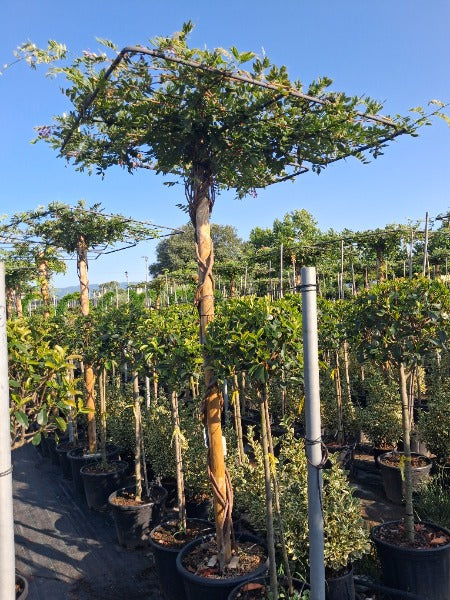

About Wisteria Sinensis Pleached Roof 65 Litre Pot Stem 240cm
Wisteria sinensis – Iconic Chinese Wisteria with Breathtaking Violet-Blue Blooms and Intoxicating Fragrance
Wisteria sinensis is one of the most beloved and iconic deciduous climbers in the gardening world, instantly recognisable for its spectacular, cascading racemes of violet-blue flowers and their heady, sweet fragrance. This vigorous Chinese species blooms in mid to late spring, often before the leaves have fully opened, allowing the pendant flower clusters to take full centre stage in a truly unforgettable floral display. With its twining woody stems, lush pinnate foliage, and powerful climbing habit, Wisteria sinensis brings romance, grandeur, and timeless elegance to pergolas, arches, walls, and fences in gardens of every style.
Seasonal Beauty & Growth
- Spring: The highlight of the year arrives as dense, pendulous racemes of fragrant violet-blue flowers burst into bloom, often reaching 20–30cm in length. The display typically occurs before or alongside the emergence of fresh foliage, creating a dramatic and enchanting effect that fills the surrounding air with a rich, sweet perfume.
- Summer: As the flowers fade, the vine produces a lush, dense canopy of bright green pinnate leaves, offering dappled shade beneath pergolas and garden structures. A secondary flush of smaller blooms may occasionally appear in midsummer, extending the season of interest.
- Autumn: The foliage gradually transitions to warm golden-yellow tones before falling, adding a final splash of seasonal colour and marking the end of another magnificent year.
- Winter: Once the leaves have dropped, the thick, gnarled, twisting woody framework is revealed — a striking architectural feature in its own right that brings structure and character to the garden throughout the colder months.
Structure & Form
Wisteria sinensis is a vigorous, fast-growing climber capable of reaching heights of 9–12m or more, with a spread to match, making it ideally suited to covering large vertical structures. It twines anti-clockwise, wrapping powerfully around its supports to form a robust, permanent framework over time. The pinnate leaves, composed of 7–13 leaflets, create a fine-textured, verdant canopy throughout summer. Its long flower racemes open simultaneously along their full length — a distinguishing characteristic of the Chinese species — producing a particularly uniform and breathtaking floral spectacle.
Ideal for Various Landscapes
- Pergolas & Arches – Wisteria sinensis is the classic choice for draping over pergolas and garden arches, where its cascading blooms can be admired from below and its fragrance enjoyed at close range, creating a truly romantic garden retreat.
- Walls & Fences – Trained along wires or a trellis fixed to a sunny wall or fence, this wisteria becomes a dramatic living feature, transforming even the most ordinary structure into an extraordinary focal point.
- Cottage & Traditional Gardens – Few plants are as synonymous with the classic English cottage garden as wisteria, and Wisteria sinensis fits effortlessly into informal, romantic planting schemes.
- Pollinator-Friendly Gardens – The richly fragrant flowers are a magnet for bees and other beneficial insects, making this an excellent choice for gardeners wishing to support local pollinator populations.
Growing Conditions & Care
- Position: Wisteria sinensis performs best in full sun, requiring a minimum of six hours of direct sunlight per day for the most prolific flowering. A sheltered, south- or west-facing aspect is ideal, particularly in cooler regions.
- Soil: Thrives in fertile, moist but well-drained soil. It is adaptable to a range of soil types, including loam, clay, and sandy soils, provided drainage is adequate and waterlogging is avoided.
- Hardiness: Fully hardy throughout the UK and most temperate climates, tolerating moderate to hard frosts with ease once established. Young plants may benefit from some protection in their first winter.
- Support: As a powerful twining climber, Wisteria sinensis requires a strong, sturdy support structure — robust wires, heavy-duty trellis, or well-built pergola timbers are essential to bear its considerable weight as it matures.
- Maintenance: Regular pruning is the key to keeping Wisteria sinensis flowering freely and under control. Prune twice a year — once in late summer (around August), cutting the current season's long whippy shoots back to 4–5 leaves, and again in late winter (January–February), reducing those same shoots further to 2–3 buds. This two-stage pruning regime builds up flowering spurs close to the main framework and is essential for encouraging a generous bloom each spring.
- Feeding: Avoid high-nitrogen feeds, which promote leafy growth at the expense of flowers. A low-nitrogen, high-potassium fertiliser applied in spring will help encourage prolific flowering.