
Rootball pre-order discount ends soon
Reserve rootball hedging now at pre-order prices — dug fresh and delivered when the season starts in October.


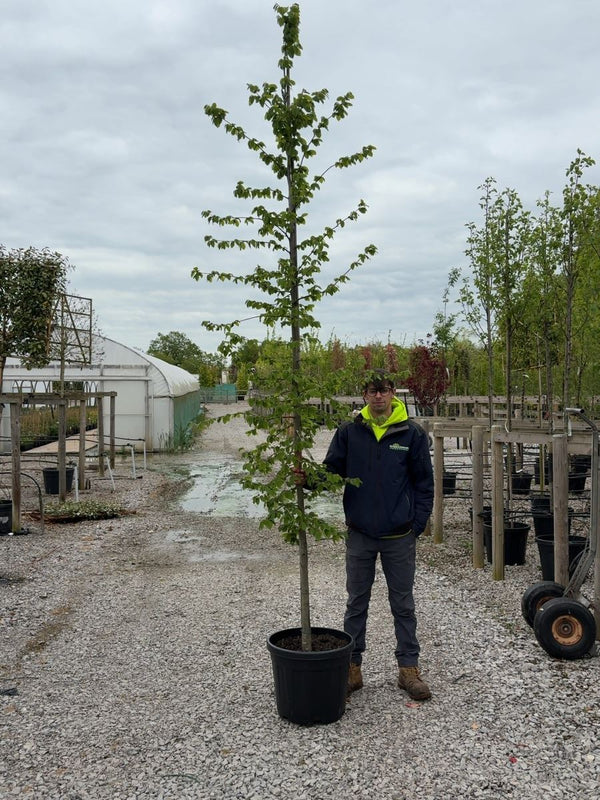

About Carpinus Betulus Heavy 10-12cm Girth Root Ball Delivery From November Onwards
Carpinus betulus, the Common Hornbeam, is one of Britain's most handsome and adaptable native trees — equally at home as a freestanding specimen, a pollard, or a closely managed formal hedge. In its natural form it develops a broadly spreading, rounded crown with a characteristically fluted and muscular grey trunk, giving it exceptional architectural presence through every season. Its pleated, oval leaves emerge fresh apple-green in spring, deepen to rich mid-green through summer, and turn glowing golden-yellow to copper in autumn. Dry, papery leaves often cling to the branches well into winter, providing structure and quiet beauty even in the coldest months.
As a British native, Common Hornbeam has a long history in managed landscapes — from ancient coppice woodland to the grand pleached avenues of formal gardens. It is equally valued for its exceptional wildlife credentials, supporting a wide range of invertebrates, birds, and small mammals through its catkins, foliage, seeds, and bark.
Growing Conditions
Position. Hornbeam thrives in full sun to partial shade and is highly tolerant of exposed, windy sites. It performs well in both open parkland and more sheltered garden settings, adapting readily to a wide range of light conditions.
Soil. One of Hornbeam's greatest strengths is its soil tolerance. Unlike beech, it copes well with heavy clay, poorly drained ground, and damp conditions, as well as loam, chalk, and sandy soils. It establishes reliably where many other trees struggle, making it a practical choice for difficult sites.
Hardiness. Fully hardy throughout the British Isles, Hornbeam withstands severe cold, frost, and exposed upland positions without difficulty.
Habit & Appearance
Natural form. Left to grow freely, Carpinus betulus develops into a medium to large deciduous tree with a broad, domed crown and distinctive fluted, silvery-grey bark that becomes increasingly sculptural with age. Pendulous catkins appear in spring alongside the emerging leaves, adding subtle seasonal interest. In autumn, clusters of ribbed nutlets held within papery bracts provide an ornamental display and a valuable food source for wildlife.
Managed forms. Hornbeam responds extremely well to coppicing, pollarding, and pleaching, making it one of the most versatile trees for formal or structured garden designs. When maintained as a hedge, it forms an exceptionally dense, fine-textured screen with a neat, formal appearance throughout the growing season.
Care & Pruning
Establishment. Young Hornbeam trees benefit from regular watering during dry spells in the first one to two growing seasons while root systems develop. Once established, they are largely self-sufficient and require little routine intervention.
Pruning as a tree. When grown as a freestanding specimen, Hornbeam requires minimal pruning. Remove any crossing, damaged, or dead branches during the dormant season — ideally between late autumn and late winter — to maintain a healthy, open structure. Avoid heavy pruning in late winter or early spring when sap is rising.
Pruning as a hedge or pleached form. For hedging or formal training, trim once or twice annually — typically in late summer, with a second lighter pass in early spring if required — to encourage dense branching and a crisp, defined outline. Hornbeam responds vigorously to hard cutting and can be rejuvenated even from old wood if needed.
Coppicing & pollarding. Hornbeam is one of the best native trees for traditional coppicing and pollarding, regenerating strongly from the base or from cut stems. These management techniques can be used to restrict ultimate size, produce structural multi-stem forms, or maintain a characteristic historic character in period landscapes.
Wildlife & Ecological Value
Native biodiversity. As a native British species, Common Hornbeam supports an exceptionally rich community of wildlife. Its foliage is a food plant for numerous moth and butterfly caterpillars; its catkins provide early-season pollen for bees; its autumn nutlets are eagerly taken by finches, tits, and small mammals; and its rough, furrowed bark offers habitat for insects and lichens. Hornbeam is a superb choice for gardens and landscapes where ecological value is a priority alongside ornamental appeal.