
-
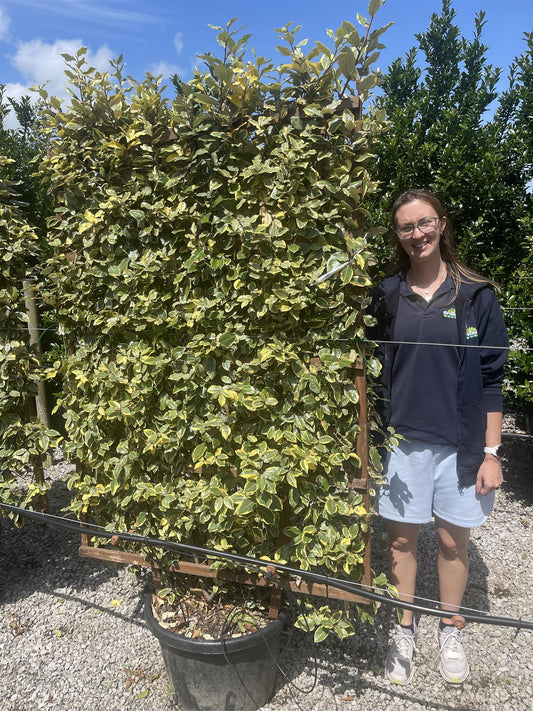
Elaeagnus x Vivileg Pleached Wall Frame 55 Litre Pot 160x110
Elaeagnus × submacrophylla 'Viveleg'PBRFull sunEvergreenGetting lowRegular price £285.00Regular price -
Elaeagnus Ebbingei Pleached Wall Frame 55 Litre Pot 160x110
Elaeagnus × ebbingeiFull sunEvergreenGetting lowRegular price £285.00Regular price -
Euonymus japonicus Pleached Wall Frame 160 x 110cm
Euonymus japonicusFull sunEvergreenPre-orderRegular price £285.00Regular price -
Trachelospermum Jasminoides Pleached Wall Frame 200cm H x 130cm W
Trachelospermum jasminoidesFull sunEvergreenPre-orderRegular price £465.00Regular price -
Prunus Lusitanica Brenelia Pleached Wall Frame 200 x 130cm
Prunus lusitanica 'Brenelia'Full sunEvergreenPre-orderRegular price £480.00Regular price



Pleached Wall Frames
Pleached Wall Frame Trees
Architectural Trained Trees for Walls, Boundaries, Screening & Contemporary Gardens
Pleached Wall Frames are specially trained trees designed to create a flat, structured canopy against a wall, fence or boundary. Their branches are carefully trained across a framework, producing an attractive living panel while keeping the overall depth of the tree relatively narrow.
Sometimes described as wall-trained trees or living wall screens, these architectural plants are an excellent way to introduce height, greenery and seasonal interest without taking up the space required by a naturally spreading tree.
Available in a range of tree varieties, Pleached Wall Frames can be used individually as striking garden features or repeated along a boundary to create a more substantial living screen.
Why Choose Pleached Wall Frames?
Pleached Wall Frames combine the beauty of a tree with a controlled, space-saving form.
Key benefits include:
- Attractive flat, trained canopy
- Excellent for planting against walls and fences
- Adds height and structure to boundaries
- Useful where planting space is limited
- Creates an architectural garden feature
- Can provide additional privacy and screening
- Ideal for contemporary and formal gardens
- Makes excellent use of vertical space
- Available in evergreen and deciduous varieties
- Can be planted individually or in a row
- Provides an established framework from planting
- Easy to maintain with regular training and pruning
What Is a Pleached Wall Frame?
A Pleached Wall Frame is a tree that has been specially grown and trained so that its branches spread across a flat vertical framework.
Rather than allowing the crown to grow naturally in all directions, selected branches are tied and trained across the frame to create a controlled, two-dimensional canopy.
This produces an attractive living panel that can be positioned against a wall, fence or boundary.
As the tree develops, new shoots can be trained into gaps in the framework, gradually creating a fuller and denser canopy.
Pleached Wall Frames for Walls
Pleached Wall Frames are particularly effective for adding greenery to large or otherwise plain walls.
Their trained shape introduces height and foliage without requiring a deep planting bed, making them particularly useful where garden space is restricted.
Depending on the variety selected, they can introduce evergreen foliage, flowers, autumn colour or other seasonal interest.
Repeated wall frames can transform a long expanse of brick, stone or rendered wall into an attractive living feature.
Pleached Wall Frames for Screening
Wall-trained trees can also provide additional privacy and screening, particularly where a standard hedge would become too wide for the available space.
Their relatively narrow profile allows greenery to be introduced vertically while retaining more usable garden space.
When several frames are planted alongside one another, the canopies can gradually develop into a more continuous screen.
The amount of privacy provided will depend on the tree variety, frame dimensions, planting distance and maturity of the foliage.
Pleached Wall Frames for Small Gardens
The flat growth habit of a Pleached Wall Frame makes it particularly useful in smaller gardens and narrow planting areas.
Instead of allowing a tree to develop a wide natural canopy, the growth is trained across the framework.
This allows you to introduce the height and impact of a tree while keeping its depth more controlled.
They can work particularly well in courtyards, narrow borders, town gardens and alongside patios where every metre of planting space is valuable.
Evergreen & Deciduous Wall Frames
Pleached Wall Frames are available using a range of different tree varieties, so their appearance can vary considerably.
Evergreen wall frames retain foliage throughout the year and can be particularly useful where screening is a priority.
Deciduous wall frames provide changing seasonal interest, with fresh spring foliage, summer growth and often attractive autumn colour before losing their leaves for winter.
Flowering varieties can provide an additional display at certain times of year.
The right choice will depend on the position, available space and the effect you want to create.
Where to Plant Pleached Wall Frames
These trained trees can be used wherever a strong vertical feature is required without excessive depth.
They are particularly effective:
- Against garden walls
- Along fences
- Beside boundaries
- In narrow borders
- Around patios and terraces
- In courtyard gardens
- In contemporary gardens
- In formal planting schemes
- Along pathways
- Around seating areas
- As living garden features
- Where additional screening is required
Always consider the requirements and eventual size of the individual tree variety when choosing the planting position.
Pleached Wall Frames for Contemporary Gardens
The clean lines and geometric form of Pleached Wall Frames make them particularly effective in modern garden design.
They work beautifully against brick, stone, timber, rendered walls and contemporary fencing.
The structured framework can be repeated along a boundary to create rhythm and symmetry, while softer planting underneath provides contrast.
Used individually, a wall frame can also become a striking focal point, particularly when positioned against a simple background.
Planting Pleached Wall Frame Trees
Good preparation is particularly important when planting larger trained trees.
Prepare a generous planting hole and loosen the surrounding soil before positioning the tree.
The top of the rootball and natural root flare should remain approximately level with the surrounding ground. Avoid burying the lower trunk beneath additional soil or mulch.
Backfill carefully, gently firm the soil and water thoroughly.
Allow sufficient distance between the frame and any solid wall or fence so there is space for airflow, growth and future maintenance.
Supporting Pleached Wall Frames
Newly planted Pleached Wall Frames require appropriate support while their root systems establish.
The tree should be secured sufficiently to prevent excessive movement of the rootball, particularly in exposed positions where the large flat canopy may catch the wind.
Supports, ties and fixings should be checked regularly to ensure they remain secure without damaging the trunk or branches.
The trained frame itself should also remain appropriately supported while the plant establishes.
Watering Pleached Wall Frames
Regular watering is essential during establishment.
Provide a deep and thorough soak around the complete rootball, rather than applying small amounts of water only to the soil surface.
Trees positioned close to walls and fences may sometimes receive less natural rainfall due to the rain-shadow effect, making careful watering particularly important.
Continue monitoring soil moisture during warm, dry and windy weather, particularly throughout the first few growing seasons.
Maintaining the Wall Frame
Pleached Wall Frames require ongoing training and pruning to maintain their distinctive flat shape.
As fresh shoots develop, suitable growth can be:
- Trained across the framework
- Gently tied into position
- Used to fill gaps in the canopy
- Trimmed where it extends beyond the desired shape
The exact timing and amount of pruning will depend on the tree variety.
Regular light maintenance is generally preferable to allowing excessive growth to develop and then carrying out severe pruning.
How Long Does a Pleached Wall Frame Take to Fill Out?
The time required for the framework to become densely covered will depend on the tree variety, initial size, growing conditions and level of aftercare.
The trained frame provides an immediate outline, but the canopy will continue to mature after planting.
Healthy new shoots can be directed into less-developed areas of the frame, gradually producing a fuller and more established appearance.
Good watering and appropriate feeding will help support healthy new growth.
Planting Under Pleached Wall Frames
The clear stem and relatively narrow canopy leave useful planting space beneath Pleached Wall Frames.
Depending on the amount of sun and shade, suitable companion plants can include:
- Ferns
- Heuchera
- Hellebores
- Hostas
- Geraniums
- Hydrangeas
- Lavender
- Salvia
- Nepeta
- Ornamental grasses
- Ground-cover plants
- Low-growing evergreen shrubs
Choose plants according to the light and moisture conditions created by the particular wall and tree canopy.
Pleached Wall Frames vs Traditional Pleached Trees
Both forms use carefully trained branches, but they can serve slightly different purposes.
Traditional pleached trees are commonly used to create elevated screening above clear stems, often along boundaries or above fences.
Pleached Wall Frames are particularly suited to creating a flat living feature against or alongside a wall or fence, where keeping the depth of the canopy controlled is important.
Both offer an excellent way to introduce strong architectural lines and mature structure into a garden.
Pleached Wall Frames vs Roof Frames
Pleached Wall Frames and Pleached Roof Frames use similar training techniques but create very different shapes.
Wall Frames are trained vertically, producing a flat upright panel of foliage.
Roof Frames are trained horizontally, creating an overhead canopy that can be used above walkways, seating areas and terraces.
This makes Wall Frames particularly useful for vertical screening and boundaries, while Roof Frames are designed to create an architectural canopy overhead.
Buy Pleached Wall Frames Online
Our range of Pleached Wall Frame Trees for sale provides an attractive solution for adding greenery, height and architectural structure to walls, fences and garden boundaries.
Available in a selection of tree varieties and sizes, they can be used individually as statement features or planted in groups to create a more continuous living screen.
With their carefully trained branches and space-saving form, Pleached Wall Frames are particularly effective for contemporary gardens, courtyards, narrow borders, privacy planting and architectural landscaping.
Shop our range of Pleached Wall Frames online and create an elegant living feature with year-round structure and seasonal interest.