

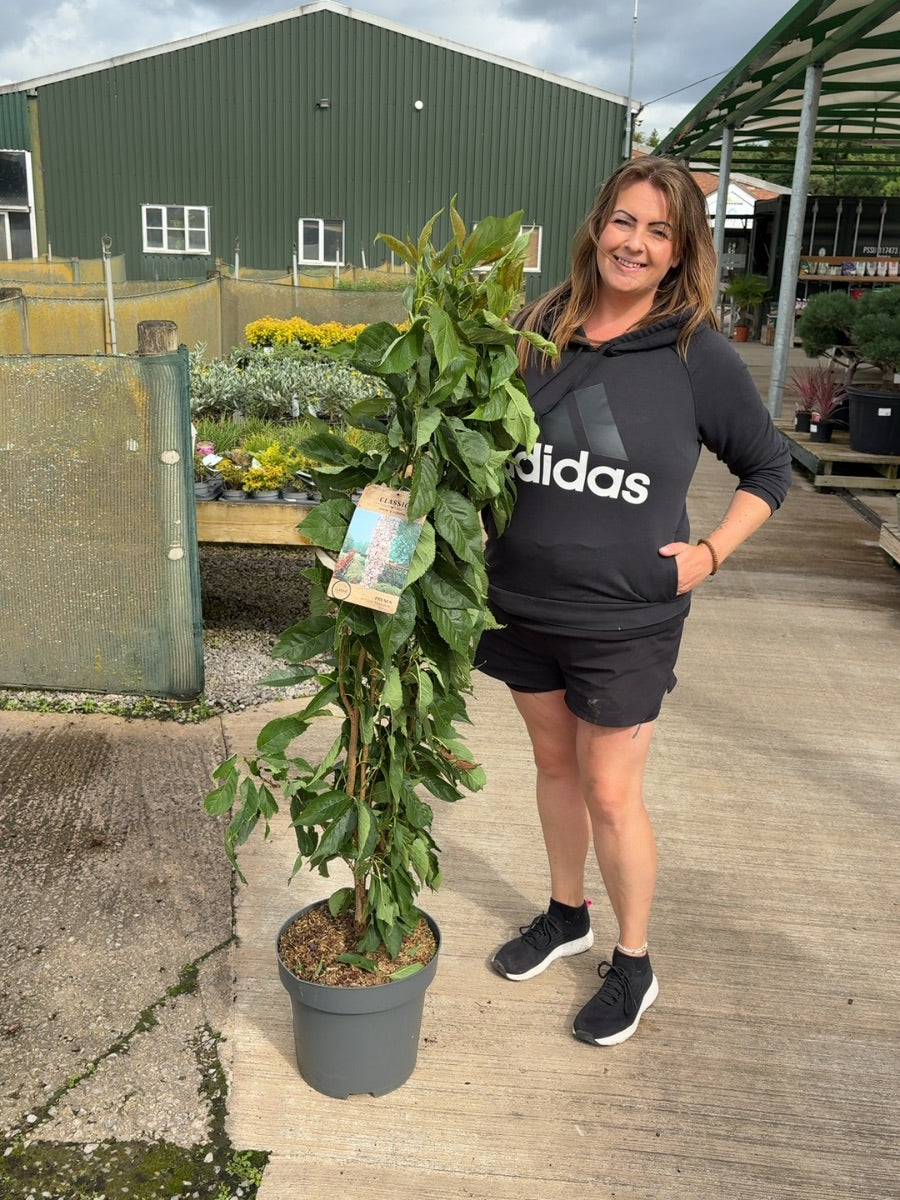
About Prunus Amanogawa 12 Litre Pot 125-150cm
Cherry 'Amanogawa' (Prunus 'Amanogawa') – Elegant Columnar Flowering Cherry for Gardens of Every Size
Prunus 'Amanogawa' is one of the most distinctive and widely loved ornamental cherries available, prized above all for its remarkably narrow, fastigiate habit — growing tall and slender like a living column. Named after the Japanese word for the Milky Way, it brings a breath-taking burst of blossom each spring, making it a true seasonal highlight in any garden setting.
Its upright form makes it an outstanding choice where space is limited but vertical interest and floral drama are desired. Whether used as a striking focal point, planted in an avenue, or positioned to frame an entrance or boundary, 'Amanogawa' delivers exceptional ornamental value across the seasons — from its spring blossom and summer foliage to its warm autumn colour.
Key Features
Distinctive narrow, columnar habit — ideal for confined spaces and smaller gardens
Abundant semi-double, pale pink, fragrant blossoms in mid to late spring
Attractive bronze-green foliage in summer, turning rich amber and orange in autumn
Fully hardy and reliable across UK gardens
Excellent as a specimen tree, avenue planting, or architectural accent
Habit & Appearance
Form: 'Amanogawa' is defined by its strongly upright, fastigiate growth habit, with branches held closely and vertically to form a tight, columnar silhouette. This makes it one of the most architecturally useful of all ornamental cherries, offering significant height without the wide spread of more traditional tree forms.
Flowers: In mid to late spring, the tree is smothered in clusters of semi-double, shell-pink blossoms with a delicate, sweet fragrance. The floral display is generous and showy, appearing just as or shortly after the new leaves begin to emerge, creating a wonderfully soft and romantic effect.
Foliage: The leaves emerge with an attractive bronze-green flush in spring, maturing to mid-green through the summer months. As temperatures cool in autumn, the foliage transforms into warm tones of amber, orange, and red, providing a second season of ornamental interest before leaf fall.
Ultimate Size: 'Amanogawa' typically reaches 6–8 metres in height at maturity, with a spread of no more than 1.5–2.5 metres — its columnar form is retained throughout its life, making it reliably predictable in garden planning.
Growing Conditions
Position: Best grown in full sun, which encourages the most prolific flowering and richest autumn colour. A sheltered spot is beneficial where possible, as this helps protect the blossom from late spring frosts and strong winds. 'Amanogawa' will tolerate light partial shade, though flowering may be slightly reduced.
Soil: Performs best in a fertile, moist but well-drained soil. It is reasonably adaptable and will grow in a range of soil types, including loam and chalk-based soils, provided drainage is adequate. Avoid poorly drained or persistently waterlogged ground, which can lead to root stress and disease.
Hardiness: Fully hardy throughout the UK and most of Northern Europe, tolerating typical winter temperatures without difficulty. Young plants in their first season may benefit from protection against severe late frosts during the flowering period.
Care & Pruning
Watering: Water regularly throughout the first growing season to support strong establishment. Once settled, 'Amanogawa' is reasonably self-sufficient in average conditions, though it will benefit from watering during extended dry spells, particularly in lighter, free-draining soils.
Feeding: Apply a balanced general-purpose fertiliser in early spring to support healthy growth and flowering. An annual mulch of well-rotted organic matter around the base of the tree helps retain soil moisture, suppress weeds, and gradually improve soil fertility — keep the mulch clear of the trunk itself.
Pruning: 'Amanogawa' requires very little pruning to maintain its characteristic upright form, which it naturally holds without intervention. Any pruning that is needed — such as the removal of dead, damaged, or crossing branches — should be carried out immediately after flowering in late spring or during the summer months. Avoid pruning in autumn or winter, as ornamental cherries are susceptible to silver leaf and other fungal diseases entering through pruning wounds during the dormant season.
Pests & Disease: Generally trouble-free when grown in appropriate conditions. Ornamental cherries can occasionally be affected by aphids, caterpillars, or bacterial canker. Good planting practice — including well-drained soil and summer pruning — goes a long way towards keeping the tree healthy and vigorous. Inspect foliage periodically during the growing season and treat any infestations promptly.
For a tree that combines architectural elegance, spectacular spring blossom, and beautiful autumn colour in a slim, space-saving form, Prunus 'Amanogawa' is an outstanding choice — a true four-season performer that brings the spirit of a Japanese cherry garden to even
Plants well with
Our growers' picks to plant alongside Prunus Amanogawa 12 Litre Pot 125-150cm for a fuller, longer-lasting display.
-
Amelanchier Laevis Ballerina 12 Litre Pot 80-100cm
Amelanchier laevis 'Ballerina'Full sunDeciduousGetting lowRegular price £55.50Regular price -
Magnolia Black Tulip 20 Litre Pot 150/175cm
Magnolia Black Tulip ('Jurmag1')Full sunDeciduousGetting lowRegular price £193.50Regular price -
Geranium Johnson's Blue 2 Litre Pot
Geranium × johnsonii 'Johnson's Blue'Full sunDeciduousIn stockRegular price £4.60Regular price


