

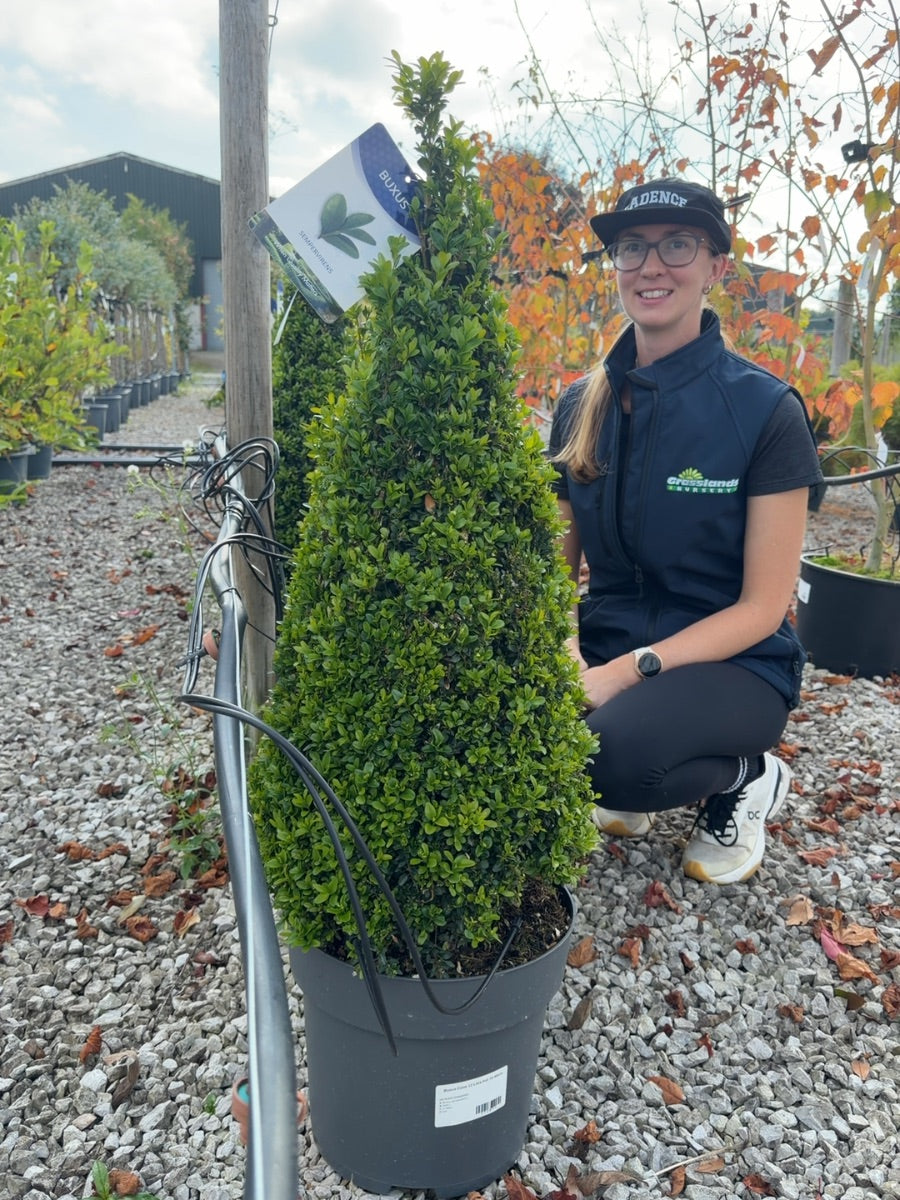

About Buxus Cone 12 Litre Pot 70-80cm
Buxus sempervirens, commonly known as Box or Common Box, is one of Britain's most beloved and versatile evergreen shrubs. Renowned for its small, glossy, dark green leaves and naturally dense, compact habit, Box has been a cornerstone of formal garden design for centuries — lending structure, symmetry, and year-round greenery to gardens of every scale and style.
Whether clipped into precise geometric hedges, shaped into elegant topiary, or left to grow as a softly rounded specimen shrub, Box brings an air of timeless sophistication. Its slow, steady growth and remarkable tolerance of trimming make it uniquely suited to gardeners who value control, precision, and lasting form.
Habit & Appearance
Dense, evergreen foliage with year-round appeal. Buxus sempervirens is a slow-growing, multi-stemmed shrub that naturally forms a dense, rounded mound over time. Left unpruned, it can eventually develop into a small tree, but it is most commonly maintained as a compact hedge or shaped specimen through regular clipping. The leaves are small, oval, leathery, and a rich, lustrous dark green on the upper surface — providing a refined, formal texture that complements both traditional and contemporary planting schemes.
Tiny, inconspicuous flowers appear in spring, clustered in the leaf axils and carrying a faintly sweet, distinctive scent that many gardeners find characteristic of the species. Though modest in appearance, these flowers are a valuable early nectar source for bees and other pollinators.
Growing Conditions
Exceptionally adaptable across a wide range of conditions. One of Box's greatest strengths is its flexibility — it performs reliably in full sun, partial shade, or even deep shade, making it one of the few shrubs capable of thriving beneath the canopy of trees or in north-facing aspects where other plants struggle.
Soil: Buxus sempervirens grows best in a fertile, well-drained soil. It will tolerate chalk, clay, and sandy soils provided drainage is adequate, but will not thrive in waterlogged or persistently boggy conditions. A neutral to slightly alkaline pH is ideal, though Box copes well across a broad pH range.
Position: Suitable for exposed or sheltered sites. Box is wind-tolerant and performs well in coastal gardens, urban environments, and formal courtyard settings alike. It is fully hardy across the UK and most of northern Europe, with excellent cold and frost resistance once established.
Care & Pruning
Low maintenance once established, with straightforward seasonal care. During the first growing season, keep plants consistently moist, particularly during dry spells, to allow the root system to establish fully. Once settled, Box is relatively drought-tolerant and requires only occasional watering in prolonged dry periods.
Feeding: Apply a balanced slow-release fertiliser or a dedicated box fertiliser in spring to support healthy, vigorous growth and maintain rich, dark foliage colour. A second light feed in early summer can be beneficial for plants under high clipping pressure.
Pruning: Clip once or twice a year to maintain a neat, defined shape — late spring (after the risk of late frosts has passed) and late summer are the traditional timings. Avoid clipping in very hot, sunny spells, which can scorch freshly cut foliage. Box responds well to hard renovation pruning if plants become overgrown or misshapen, with most specimens recovering readily when cut back into older wood in spring.
Pests & disease: Be vigilant for Box blight (Cylindrocladium buxicola) and Box tree caterpillar (Cydalima perspectalis), both of which can cause significant damage if left unchecked. Good air circulation around plants, prompt removal of affected growth, and regular monitoring will help to keep plants healthy. Organic and chemical treatment options are available for caterpillar infestations.
Garden Uses
A cornerstone plant for structure and formality in garden design. Buxus sempervirens is the classic choice for low formal hedging, knot gardens, parterres, and edging along pathways, borders, and driveways. It is equally at home clipped into balls, cones, spirals, and other topiary forms, providing strong architectural focal points in pots, borders, or as paired specimens flanking entrances.
Its year-round evergreen presence makes it an invaluable structural plant for providing a permanent framework around which seasonal planting can change and evolve. Whether used to define clean lines in a contemporary garden or to echo the historic grandeur of a traditional estate, Box remains an enduring and irreplaceable choice.
Plants well with
Our growers' picks to plant alongside Buxus Cone 12 Litre Pot 70-80cm for a fuller, longer-lasting display.
-
Taxus baccata 'Groenland' - Yew 3 Litre Pot
Taxus baccata 'Groenland'Full sunEvergreenIn stockRegular price £8.50Regular price -
Hydrangea Arborescens Annabelle 4.5 Litre Pot
Hydrangea Arborescens AnnabelleFull sunDeciduousGetting lowRegular price £21.50Regular price

