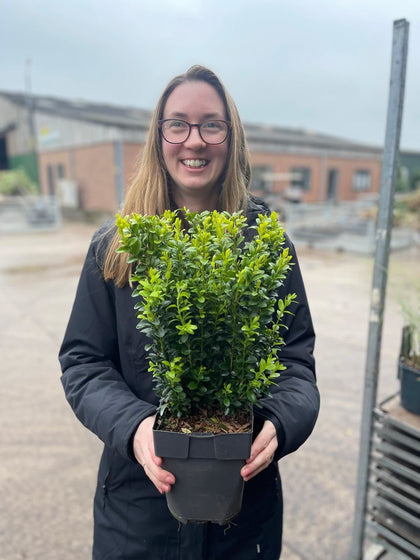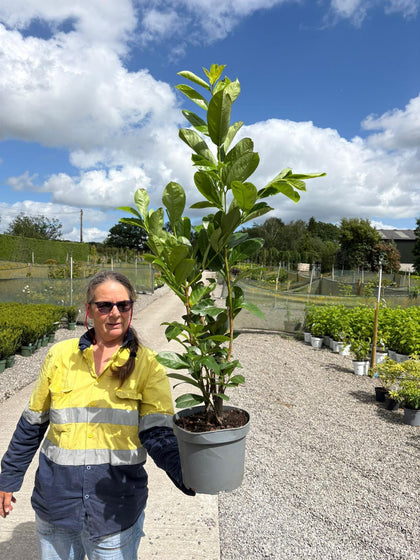
Golden Privet (Ligustrum ovalifolium 'Aureum') is a striking semi-evergreen shrub prized for its bright, two-toned foliage — oval leaves edged and flushed with rich golden yellow around a green centre. One of the most popular and recognisable hedging and garden shrubs in the UK, it brings warmth and year-round colour to boundaries, borders, and formal plantings alike. Its dense, bushy habit and vigorous growth make it as practical as it is ornamental.
In summer, clusters of small creamy-white flowers appear on untrimmed growth, attracting bees and other pollinators. These are followed in autumn by glossy black berries that provide valuable food for birds. Fully hardy and highly adaptable, Golden Privet performs well in a wide range of garden settings, from exposed urban plots to sheltered rural boundaries.
Habit & Appearance
Foliage and form. Golden Privet is a fast-growing, upright and bushy shrub with a naturally dense branching structure. Its defining feature is its foliage: oval leaves with bright golden-yellow margins and a green or grey-green centre, which together create a vivid, luminous effect. The colouring is most intense in good light and is retained through most of the year, as the plant is semi-evergreen, keeping the majority of its leaves except in the coldest winters. At maturity it can reach 3–4m if left unpruned, though it is most commonly maintained as a clipped hedge or specimen shrub at a more modest height.
Seasonal interest. Beyond the foliage, Golden Privet offers small white flowers in mid-summer on unclipped growth, which are pleasantly fragrant and attractive to pollinators. Clusters of glossy black berries follow in autumn, extending the plant's wildlife value into the colder months. The golden leaf colour provides warmth and brightness even through winter, particularly in mild conditions where most leaves are retained.
Growing Conditions
Position. Golden Privet thrives in full sun to partial shade. The best and most vivid golden leaf colour is achieved in a sunny, open position — in deep shade the foliage tends toward a greener hue, losing some of its characteristic brightness. It is well suited to exposed sites, coastal gardens, and urban environments, being tolerant of wind, pollution, and the challenging conditions common in town and city gardens.
Soil. This is a highly adaptable shrub that performs well in most soil types, including clay, chalk, sand, and loam. It prefers well-drained conditions but will tolerate moderately heavy soils provided they are not waterlogged. No special soil preparation is needed for established plants, though incorporating organic matter at planting time will help new plants establish more quickly.
Care & Pruning
Watering and establishment. Once established, Golden Privet is a low-maintenance, drought-tolerant plant that requires little intervention. During the first growing season after planting, water regularly during dry spells to encourage strong root development. After this, supplementary watering is rarely needed except in prolonged dry periods.
Pruning. Golden Privet responds extremely well to clipping and can be maintained as a formal hedge, an informal specimen shrub, or even a topiary shape. For a neat formal hedge, trim two to three times during the growing season — typically in late spring, midsummer, and early autumn — to keep growth dense and compact. For a more relaxed, informal effect, a single annual prune in late spring or early summer is sufficient. Hard pruning is well tolerated if renovation is needed; cutting back into old wood in spring will prompt vigorous regrowth. Note that regular trimming will reduce or prevent flowering and berry production — if wildlife value is a priority, allow some stems to grow unpruned.
Feeding. Golden Privet is not a demanding feeder. An annual dressing of a balanced general fertiliser in spring will support healthy growth and maintain the vibrancy of the golden foliage, particularly on poorer soils.
Ideal Uses
Versatile across garden styles. Golden Privet is suited to a wide range of uses and garden types. It is most commonly grown as a formal hedging plant for boundaries, driveways, and garden divisions, where its dense growth and attractive colour provide both privacy and visual interest throughout the year. It also works well as a standalone specimen shrub in a mixed border, providing a bright foliage contrast against darker-leaved plants. Its tolerance of pollution and tough urban conditions makes it an excellent choice for town gardens, and its wildlife value — flowers for pollinators, berries for birds — adds ecological benefit to its ornamental appeal.