Portuguese Laurel (Prunus lusitanica) – Elegant, Hardy Evergreen for Hedging, Screening and Specimen Planting
Prunus lusitanica, commonly known as Portuguese Laurel, is one of the most refined and versatile evergreen shrubs available for UK gardens. With its handsome, deep green foliage, attractive red leaf stalks, and graceful habit, it offers a more distinguished alternative to Cherry Laurel — equally tough and adaptable, but with a quieter, more polished character that suits both formal and naturalistic settings.
Widely used for hedging, screening, and topiary, Portuguese Laurel responds superbly to clipping and can be shaped into precise formal hedges or sculpted standards. Left to its own devices, it develops into a generous, billowing shrub or small multi-stemmed tree of considerable presence. In early summer it produces long, elegant racemes of small white flowers that are richly attractive to bees and other pollinators, followed by small dark fruits relished by birds. For year-round beauty combined with genuine resilience, it is difficult to surpass.
Key Features
Handsome evergreen foliage — deep glossy green leaves with distinctive deep red petioles
Excellent for formal hedging, screening, topiary, and specimen planting
Long racemes of fragrant white flowers in early summer, highly attractive to pollinators
Small dark fruits in autumn providing food for birds and wildlife
Tolerant of coastal exposure, urban pollution, and a wide range of soils
More resistant to disease than Cherry Laurel, with a finer-textured, more elegant appearance
Growing Conditions
Position: Prunus lusitanica thrives in full sun or partial shade and is one of the more adaptable evergreens for a range of aspects. It tolerates exposed, windy sites well and performs reliably in coastal gardens where salt-laden winds can trouble less robust plants. A sheltered spot will encourage the most vigorous growth, but it is by no means a delicate subject.
Soil: Performs best in moderately fertile, well-drained soil and is tolerant of chalk, clay, loam, and sandy conditions provided drainage is adequate. It copes reasonably well in dry soils once established, though growth will be most vigorous where moisture is more consistently available. Avoid permanently waterlogged ground, which can cause root problems over time.
Hardiness: Fully hardy throughout the UK and much of Northern Europe, tolerating sustained hard frosts without serious damage. It is notably hardier than many broadleaved evergreens of similar appearance, making it a dependable choice even in colder, more exposed gardens.
Habit & Appearance
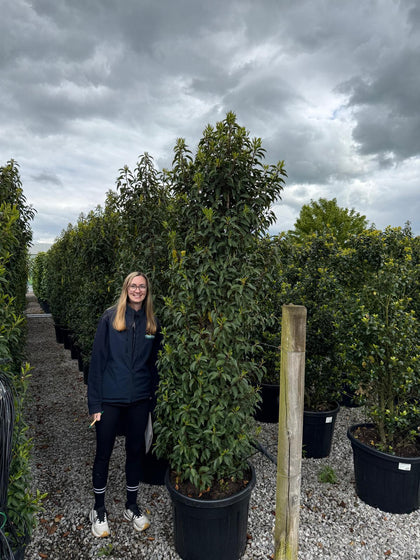
Foliage: The leaves are oval, finely toothed, and a deep, lustrous dark green above with a paler underside. One of the most distinctive features of the species is the rich red to burgundy leaf stalks, which provide a striking contrast against the dark foliage and give the plant year-round ornamental appeal even before it flowers. The overall texture is finer and more refined than that of Cherry Laurel.
Flowers & Fruit: In early to midsummer, Portuguese Laurel produces long, slender racemes of small, creamy-white flowers with a pleasant, honey-like fragrance. These are produced in abundance across the plant and are extremely popular with bees. The flowers give way to small, oval fruits that ripen from red through to deep purple-black in autumn, providing valuable food for birds.
Ultimate Size: Allowed to grow freely, Prunus lusitanica will develop into a large shrub or small tree of 6–8m in height, with a broad, rounded crown. Growth is moderate — typically 20–40cm per year — making it more manageable than the faster-growing Cherry Laurel. It is very easily maintained at any desired height and width through regular trimming.
Care & Pruning
Watering: Water consistently during the first growing season to support root establishment. Once settled in, Portuguese Laurel is reasonably drought-tolerant and requires little supplementary watering under typical UK conditions. During prolonged dry spells in the first year or two, additional irrigation will help maintain vigorous growth.
Feeding: Apply a balanced, slow-release fertiliser in spring to encourage healthy, steady growth — particularly beneficial in the first few years after planting or in poorer soils. An annual mulch of well-rotted organic matter around the base helps conserve moisture, improve soil structure, and suppress competing weeds.
Pruning: For formal hedging or topiary, trim once or twice a year — the best time is late spring to early summer after flowering has finished, with a second light trim in late summer if a particularly neat finish is desired. Because the leaves are relatively small, shears or hedging trimmers can be used without the risk of the unsightly cut-leaf browning that affects Cherry Laurel. For specimen plants grown more informally, little pruning is required beyond the removal of any crossing, damaged, or wayward branches in late spring.
Pests & Disease: Portuguese Laurel is notably more disease-resistant than Cherry Laurel, with far less susceptibility to shot hole and other fungal problems. It is generally a robust


 Value pick
 Value pick
 Value pick
 Upgrade
 Upgrade
 Upgrade