
-
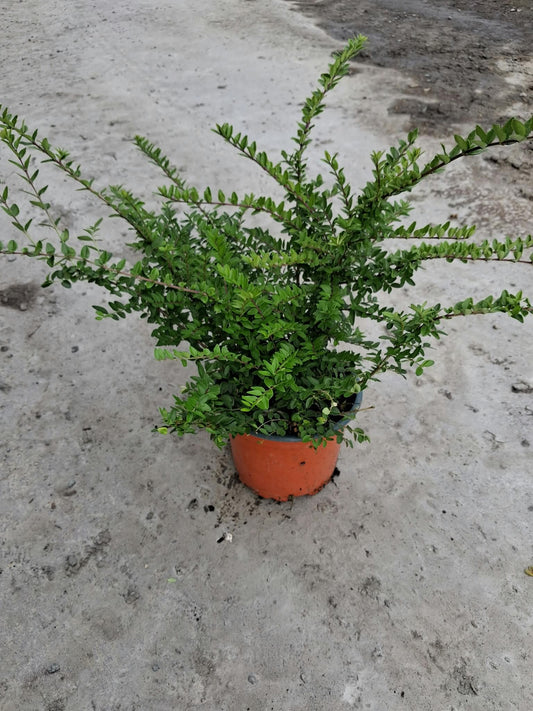
Lonicera Nit. Maigrun 2 Litre Pot
Lonicera nitida 'Maigrün'Full sunEvergreenIn stockRegular price £3.95Regular price -
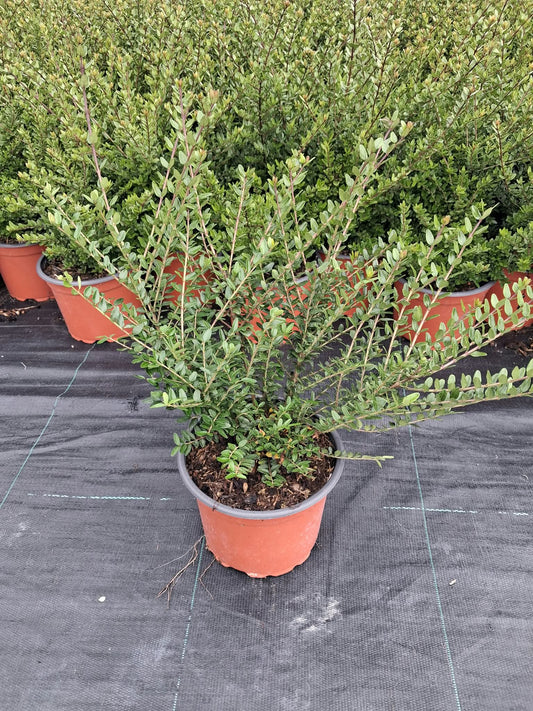
Lonicera Nitida Elegant 2 Litre Pot
Lonicera nitida 'Elegant'Full sunEvergreenIn stockRegular price £3.95Regular price


Lonicera Hedging for Fast-Growing, Evergreen Structure All Year Round
Lonicera hedging is one of the most versatile and underrated choices for UK gardens, offering dense, evergreen coverage, rapid establishment, and excellent tolerance of clipping into neat, formal shapes. The genus includes both the well-known Lonicera nitida — commonly called Box Honeysuckle — and the winter-flowering Lonicera fragrantissima, giving gardeners a broader palette than many realise. Grasslands Nursery grows one of the widest selections of Lonicera hedging varieties available to order online in the UK, supplied in quality pot-grown plants ready to establish quickly in your garden.
Whether you need a low, ornamental border hedge, a formal garden partition, or a wildlife-friendly screen, there is a Lonicera variety suited to the task. All plants are dispatched in robust nursery pots and can be planted throughout the growing season with proper care.
Why choose Lonicera for hedging?
- Fast-growing and quick to knit together into a dense, uniform screen
- Evergreen foliage on Lonicera nitida varieties provides year-round privacy
- Tolerates hard clipping and repeated trimming without dieback
- Performs well on a wide range of soils, including clay, chalk, and sandy loam
- Suitable for full sun through to partial shade, making it highly adaptable
- Excellent value — establishes quickly and requires less waiting than slower species
- Low maintenance once established, needing only two or three trims per year
- Attractive to insects, particularly when lightly flowered in spring
Is Lonicera nitida evergreen?
Lonicera nitida varieties — including the popular cultivars Maigrun, Elegant, and Ophelie — are fully evergreen in the UK, retaining their small, glossy leaves throughout the year. This makes them an outstanding choice for garden screening and formal hedging where year-round coverage is essential. Lonicera fragrantissima, by contrast, is semi-evergreen to deciduous and is grown primarily for its intensely fragrant, cream-white flowers produced during winter and early spring — a remarkable feature when little else is in bloom. If you need a reliable evergreen hedge, the Lonicera nitida cultivars are your best choice; if you want seasonal fragrance and wildlife value alongside light screening, Lonicera fragrantissima earns its place at the back of a border or as an informal hedge.
Lonicera nitida vs Buxus (Box) — which is better for hedging?
This is one of the most common questions for gardeners planning a formal, low hedge. Lonicera nitida grows considerably faster than traditional Buxus (Box) hedging and is entirely free from the threat of Box blight (Cylindrocladium buxicola) and Box tree moth — two devastating problems that have affected Box hedges across the UK. Lonicera nitida has a similar small-leaved, clippable character to Box and responds equally well to topiary shaping. It is, in short, a safer and faster alternative for formal effects. Similarly, Ilex Crenata is another Box alternative worth considering, though Lonicera tends to establish more rapidly in most UK conditions.
How far apart should I plant Lonicera hedging?
For a dense, gap-free hedge, plant Lonicera nitida at approximately 3 plants per metre (roughly 30–33 cm apart). For a slightly more open effect or for larger, more established pot sizes, 2–3 plants per metre remains a sensible guide. In exposed or windy positions, closer spacing will help plants support each other as they establish. Lonicera fragrantissima, grown as an informal or semi-formal hedge, can be spaced at around 60–75 cm apart, as it naturally forms a broader, more relaxed habit.
How tall will Lonicera hedging grow?
Lonicera nitida can reach 1–1.5 m when clipped regularly as a formal hedge, and up to 3 m or more if left largely untrimmed. With routine clipping two or three times a year — typically in spring and late summer — it maintains an excellent tight, dense form at heights between 60 cm and 120 cm, making it ideal for low-to-medium formal hedges and edging. Lonicera fragrantissima is best suited to informal hedges of 1.5–2.5 m.
Planting and care advice for Lonicera hedging
- Soil: Tolerates most well-drained to moderately moist soils; avoid waterlogged ground
- Position: Full sun to partial shade; variegated or golden cultivars colour best in sun
- Planting season: Pot-grown plants can be planted year-round, though spring and autumn give the best establishment rates
- Watering: Water thoroughly at planting and during dry spells for the first growing season; once established, Lonicera is reasonably drought-tolerant
- Feeding: Apply a balanced granular fertiliser (such as fish, blood and bone) in spring to encourage strong, healthy growth
- Pruning: Clip two to three times between April and September; avoid cutting into very old wood
Buying tip: which Lonicera variety should I choose?
For a neat, formal, Box-style hedge, Lonicera nitida Maigrun is an excellent all-rounder — compact, dense, and reliably evergreen. Lonicera nitida Elegant has a slightly more upright habit, useful if you need a taller hedge without excessive clipping. Lonicera nitida Ophelie offers attractive, slightly larger leaves and a clean, refined appearance particularly suited to contemporary planting schemes. If winter fragrance is your priority, Lonicera fragrantissima is the stand-out choice, with powerfully scented flowers from December through to February. All are available in quality pot-grown formats at Grasslands, ready to plant on arrival.
Explore more hedging options at Grasslands
If you are comparing options for your garden boundary or formal hedge, you may also find our collections of Evergreen Hedging, Laurel Hedging, Yew Hedging, and Elaeagnus Hedging useful. For budget-conscious projects, take a look at our Hedging Deals, or browse the full Hedging Plants collection for the complete range. Bare root and rootball options are available seasonally via our Bare Root Hedging Pre Order and Rootball Hedging Pre Order collections.